旧 (jiù) means "old; used; former" in Chinese. It has 5 strokes with the radical 日, and is HSK Level 3.
Rated 2.9/5 in difficulty (moderate).
Harder than 24% of HSK Level 3 characters.
Appears in 3+ common words including 旧衣服 (jiù yī fú), 叙旧 (xù jiù), 依旧 (yī jiù).
Hanzi Writer's stroke validation shows learners typically need 5-8 attempts to write 旧 with correct proportion and order.
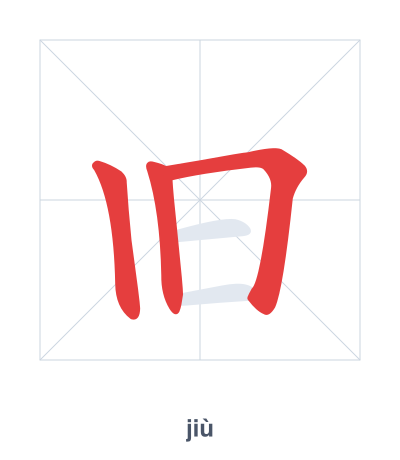
Open Hanzi Writer to see the animated stroke order and practice writing 旧 with real-time feedback.
The character 旧 (jiù) is written with 5 strokes. Follow the standard Chinese stroke order: top to bottom, left to right, outside before inside. The radical 日 is one of its key components.
Practice the correct stroke order with the Hanzi Writer app to see animated stroke-by-stroke guidance with real-time feedback.
旧 means old; used; former.
As an HSK Level 3 character, 旧 is an intermediate-level character.
The character 旧 combines the radical 日 (sun, representing time) with a vertical stroke 丨 that suggests a marker or division, together indicating something that has passed many days—thus 'old' or 'former'.
💡 Memory Tip: Picture the sun (日) with a long vertical scratch (丨) across it, showing it's old and worn out.
这些是旧衣服。
zhè xiē shì jiù yī fú
These are old clothes.
我们一起叙叙旧。
wǒ men yì qǐ xù xù jiù
Let's catch up together.
他依旧住在那里。
tā yī jiù zhù zài nà lǐ
He still lives there.
Open Hanzi Writer to see the animated stroke order and practice writing 旧 with real-time feedback.
✨ Animated stroke order · Handwriting recognition · HSK-graded practice · Free to use
旧 is composed of the radical 日 (sun/day) on the left and the component 丨 (a vertical stroke) on the right. The radical 日 suggests time or days, and the vertical stroke can be imagined as a mark of something that has passed, together conveying the idea of 'old' or 'past time.' This structure visually represents something related to a previous day or era.