昀 (yún) means "Sunlight (often used in names)." in Chinese. It has 8 strokes with the radical 日.
Rated 3.7/5 in difficulty (challenging).
Appears in 3+ common words including 昀昀 (yún yún), 昀光 (yún guāng), 昀晖 (yún huī).
Due to its 8 strokes, Hanzi Writer's error detection shows 昀 requires focused practice — most learners need 10+ attempts for consistent accuracy.
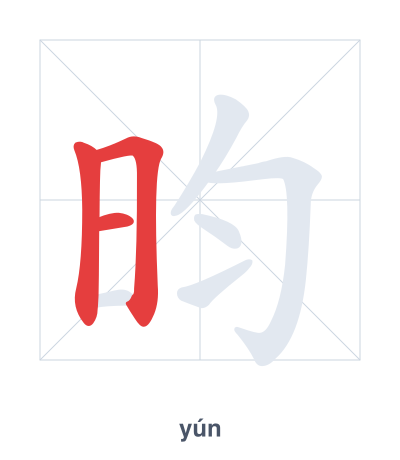
Open Hanzi Writer to see the animated stroke order and practice writing 昀 with real-time feedback.
The character 昀 (yún) is written with 8 strokes. Follow the standard Chinese stroke order: top to bottom, left to right, outside before inside. The radical 日 is one of its key components.
Practice the correct stroke order with the Hanzi Writer app to see animated stroke-by-stroke guidance with real-time feedback.
昀 means Sunlight (often used in names)..
昀 is a phono-semantic compound combining the radical 日 (sun) for meaning and the phonetic component 匀 (yún, meaning 'even, balanced') for sound. Together, they evoke the image of sunlight that is evenly and gently spread, like a balanced glow.
💡 Memory Tip: Picture the sun (日) shining evenly (匀) to create warm sunlight, perfect for a bright name.
阳光昀昀。
yáng guāng yún yún
The sunlight is bright and clear.
昀光很温暖。
yún guāng hěn wēn nuǎn
The sunlight is very warm.
昀晖很漂亮。
yún huī hěn piào liàng
The sunlight is very beautiful.
Open Hanzi Writer to see the animated stroke order and practice writing 昀 with real-time feedback.
✨ Animated stroke order · Handwriting recognition · HSK-graded practice · Free to use
昀 is made of the radical 日 (sun) on the left and the component 匀 (yún, meaning even or balanced) on the right. The sun radical directly connects to its meaning of sunlight, while 匀 adds a phonetic hint for pronunciation. Together, they create the idea of balanced or gentle sunlight.