旱 (hàn) means "drought; dry" in Chinese. It has 7 strokes with the radical 日, and is HSK Level 7.
Rated 3.5/5 in difficulty (challenging).
Harder than 18% of HSK Level 7 characters.
Appears in 3+ common words including 干旱 (gān hàn), 旱灾 (hàn zāi), 旱地 (hàn dì).
Due to its 7 strokes, Hanzi Writer's error detection shows 旱 requires focused practice — most learners need 10+ attempts for consistent accuracy.
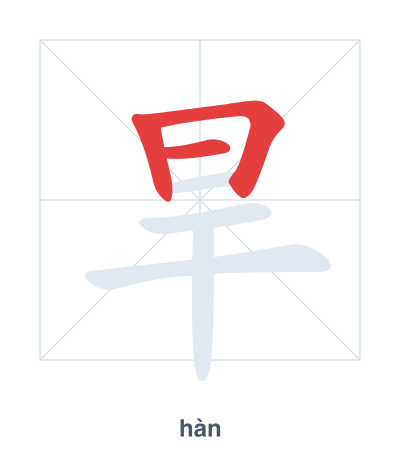
Open Hanzi Writer to see the animated stroke order and practice writing 旱 with real-time feedback.
The character 旱 (hàn) is written with 7 strokes. Follow the standard Chinese stroke order: top to bottom, left to right, outside before inside. The radical 日 is one of its key components.
Practice the correct stroke order with the Hanzi Writer app to see animated stroke-by-stroke guidance with real-time feedback.
旱 means drought; dry.
As an HSK Level 7 character, 旱 is an intermediate-level character.
旱 combines the sun (日) above and 干 (a pole or shield, also meaning 'dry') beneath, suggesting the sun's heat drying out the land. The character thus visually depicts the sun causing drought, with 干 reinforcing the sense of aridity.
💡 Memory Tip: Picture the blazing sun (日) scorching a dry, cracked field, with a withered stick (干) standing in the dust.
这里的天气很干旱。
zhè lǐ de tiān qì hěn gān hàn
The weather here is very dry.
去年发生了旱灾。
qù nián fā shēng le hàn zāi
A drought occurred last year.
农民在旱地种菜。
nóng mín zài hàn dì zhòng cài
Farmers are growing vegetables in dry land.
Open Hanzi Writer to see the animated stroke order and practice writing 旱 with real-time feedback.
✨ Animated stroke order · Handwriting recognition · HSK-graded practice · Free to use
旱 is made of 日 (sun) on top and 干 (dry) below. The sun represents heat, and 干 means dry, so together they convey the idea of drought or dry conditions.