御 (yù) means "To drive; to manage; imperial; to resist." in Chinese. It has 12 strokes with the radical 彳, and is HSK Level 7.
Rated 4.2/5 in difficulty (advanced).
Harder than 55% of HSK Level 7 characters.
Appears in 3+ common words including 御寒 (yù hán), 防御 (fáng yù), 御用 (yù yòng).
Due to its 12 strokes, Hanzi Writer's error detection shows 御 requires focused practice — most learners need 10+ attempts for consistent accuracy.
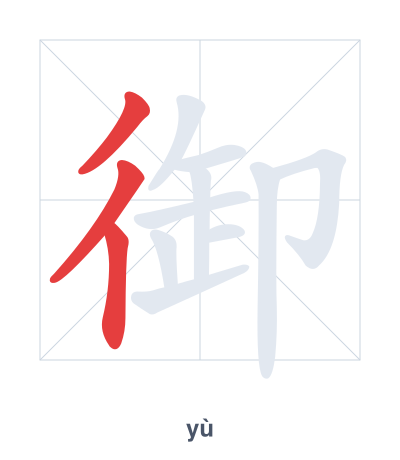
Open Hanzi Writer to see the animated stroke order and practice writing 御 with real-time feedback.
The character 御 (yù) is written with 12 strokes. Follow the standard Chinese stroke order: top to bottom, left to right, outside before inside. The radical 彳 is one of its key components.
Practice the correct stroke order with the Hanzi Writer app to see animated stroke-by-stroke guidance with real-time feedback.
御 means To drive; to manage; imperial; to resist..
As an HSK Level 7 character, 御 is an intermediate-level character.
御 originally showed a hand holding a whip (攵) and a foot (止) on a road (彳), depicting the act of driving a chariot. Over time, the hand became 午 (a pestle) and a kneeling person (卩) was added, but the core meaning of controlling a vehicle or managing remains. The component 彳 emphasizes movement, while 止 and 卩 together suggest the driver's posture and control.
💡 Memory Tip: Imagine a driver (彳) stepping (止) on the pedal while cracking a whip (午) over a kneeling servant (卩)—that's how you drive an imperial chariot with authority.
这件大衣很御寒。
zhè jiàn dà yī hěn yù hán
This coat is very good at keeping out the cold.
这种防御很有用。
zhè zhǒng fáng yù hěn yǒu yòng
This defense is very useful.
这是他的御用笔。
zhè shì tā de yù yòng bǐ
This is his exclusive pen.
Open Hanzi Writer to see the animated stroke order and practice writing 御 with real-time feedback.
✨ Animated stroke order · Handwriting recognition · HSK-graded practice · Free to use
御 is made of three parts: the left radical 彳 (suggesting movement or walking), the upper right 止 (meaning stop), and the lower right 㐄 (shaped like a whip). Together they create the idea of controlling or directing movement, which connects to meanings like "to drive" and "to manage."