徕 (lái) means "To induce / come" in Chinese. It has 10 strokes with the radical 彳.
Rated 4.2/5 in difficulty (advanced).
Appears in 3+ common words including 招徕 (zhāo lái), 徕卡 (lái kǎ), 招徕生意 (zhāo lái shēng yì).
Due to its 10 strokes, Hanzi Writer's error detection shows 徕 requires focused practice — most learners need 10+ attempts for consistent accuracy.
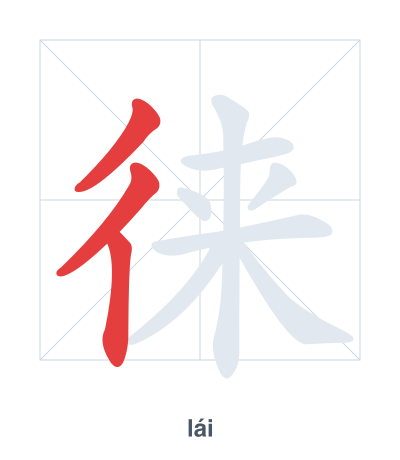
Open Hanzi Writer to see the animated stroke order and practice writing 徕 with real-time feedback.
The character 徕 (lái) is written with 10 strokes. Follow the standard Chinese stroke order: top to bottom, left to right, outside before inside. The radical 彳 is one of its key components.
Practice the correct stroke order with the Hanzi Writer app to see animated stroke-by-stroke guidance with real-time feedback.
徕 means To induce / come.
徕 combines the walking radical 彳 (a crossroads or steps) with 来 (lái, 'come'), creating a compound that means 'to come' or 'induce someone to come.' The 彳 component emphasizes movement or leading, while 来 provides the sound and core idea of arrival.
💡 Memory Tip: Picture a tiny person (彳) waving a sign that says 'COME' (来) to lure a friend over—that's inducing them to 徕.
商店在招徕顾客。
shāng diàn zài zhāo lái gù kè
The store is attracting customers.
他买了一台徕卡。
tā mǎi le yī tái lái kǎ
He bought a Leica camera.
他在招徕生意。
tā zài zhāo lái shēng yì
He is soliciting business.
Open Hanzi Writer to see the animated stroke order and practice writing 徕 with real-time feedback.
✨ Animated stroke order · Handwriting recognition · HSK-graded practice · Free to use
The character 徕 consists of the radical 彳 (double person radical, related to walking) on the left and 来 (lái, meaning 'come') on the right. Together, they suggest the idea of 'coming' or 'making someone come' — hence the meanings 'to induce' or 'to come'. The radical adds a sense of movement or action.