婴 (yīng) means "Baby; infant" in Chinese. It has 11 strokes with the radical 女, and is HSK Level 7.
Rated 4.2/5 in difficulty (advanced).
Harder than 51% of HSK Level 7 characters.
Appears in 3+ common words including 婴儿 (yīng ér), 婴幼儿 (yīng yòu ér), 女婴 (nǚ yīng).
Due to its 11 strokes, Hanzi Writer's error detection shows 婴 requires focused practice — most learners need 10+ attempts for consistent accuracy.
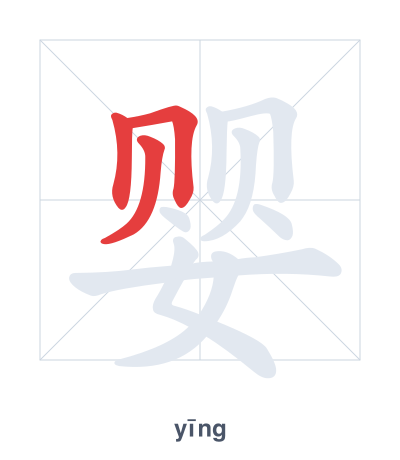
Open Hanzi Writer to see the animated stroke order and practice writing 婴 with real-time feedback.
The character 婴 (yīng) is written with 11 strokes. Follow the standard Chinese stroke order: top to bottom, left to right, outside before inside. The radical 女 is one of its key components.
Practice the correct stroke order with the Hanzi Writer app to see animated stroke-by-stroke guidance with real-time feedback.
婴 means Baby; infant.
As an HSK Level 7 character, 婴 is an intermediate-level character.
婴 combines 女 (woman) with 賏 (two shell necklaces), originally depicting a woman wearing a necklace. It later came to mean 'baby' because infants were often adorned with necklaces or carried close to the neck.
💡 Memory Tip: Picture a woman (女) wearing two stacked shell necklaces (贝贝) as she cradles a baby against her chest.
婴儿在摇篮里睡觉。
yīng ér zài yáo lán lǐ shuì jiào
The baby is sleeping in the cradle.
超市有婴幼儿用品。
chāo shì yǒu yīng yòu ér yòng pǐn
The supermarket has baby products.
她生了一个健康的女婴。
tā shēng le yí gè jiàn kāng de nǚ yīng
She gave birth to a healthy baby girl.
Open Hanzi Writer to see the animated stroke order and practice writing 婴 with real-time feedback.
✨ Animated stroke order · Handwriting recognition · HSK-graded practice · Free to use
婴 is a top-bottom character: the top is 贝 (shell, symbolizing value), and the bottom is 女 (woman). Together, they suggest a woman holding something precious — a baby. So the character represents a baby, something treasured like a shell.