幼 (yòu) means "Young" in Chinese. It has 5 strokes with the radical 幺, and is HSK Level 4.
Rated 2.9/5 in difficulty (moderate).
Harder than 12% of HSK Level 4 characters.
Appears in 3+ common words including 幼儿园 (yòu ér yuán), 幼儿 (yòu ér), 幼小 (yòu xiǎo).
Hanzi Writer's stroke validation shows learners typically need 5-8 attempts to write 幼 with correct proportion and order.
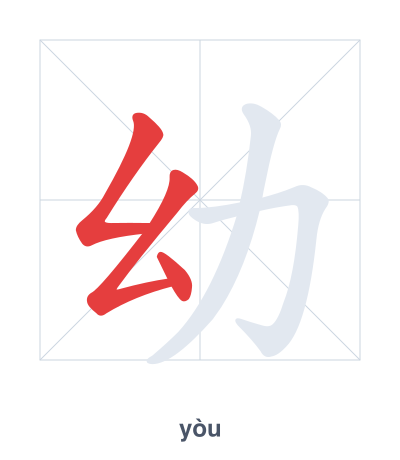
Open Hanzi Writer to see the animated stroke order and practice writing 幼 with real-time feedback.
The character 幼 (yòu) is written with 5 strokes. Follow the standard Chinese stroke order: top to bottom, left to right, outside before inside. The radical 幺 is one of its key components.
Practice the correct stroke order with the Hanzi Writer app to see animated stroke-by-stroke guidance with real-time feedback.
幼 means Young.
As an HSK Level 4 character, 幼 is an intermediate-level character.
幼 combines 幺, meaning 'tiny' or 'delicate,' with 力, meaning 'strength' or 'power.' Together, they depict a small or tender strength, symbolizing a young person who has limited but growing power.
💡 Memory Tip: Imagine a tiny thread (幺) trying to pull a heavy weight (力), like a young child struggling to lift something big.
弟弟在读幼儿园。
dì di zài dú yòu ér yuán
Little brother is attending kindergarten.
幼儿需要照顾。
yòu ér xū yào zhào gù
Young children need care.
他的年纪还很幼小。
tā de nián jì hái hěn yòu xiǎo
He is still very young.
Open Hanzi Writer to see the animated stroke order and practice writing 幼 with real-time feedback.
✨ Animated stroke order · Handwriting recognition · HSK-graded practice · Free to use
The character 幼 is composed of 幺 (yāo, meaning 'tiny' or 'small') on the left and 力 (lì, meaning 'strength' or 'power') on the right. The small component 幺 suggests something little or delicate, while 力 implies the idea of force or effort—together they convey the sense of a 'young' being that has little strength.