岐 (qí) means "Divergent; branching" in Chinese. It has 7 strokes with the radical 山.
Rated 3.5/5 in difficulty (challenging).
Appears in 3+ common words including 岐路 (qí lù), 岐山 (qí shān), 岐山面 (qí shān miàn).
Due to its 7 strokes, Hanzi Writer's error detection shows 岐 requires focused practice — most learners need 10+ attempts for consistent accuracy.
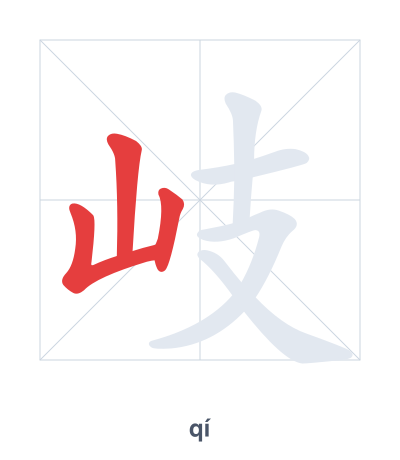
Open Hanzi Writer to see the animated stroke order and practice writing 岐 with real-time feedback.
The character 岐 (qí) is written with 7 strokes. Follow the standard Chinese stroke order: top to bottom, left to right, outside before inside. The radical 山 is one of its key components.
Practice the correct stroke order with the Hanzi Writer app to see animated stroke-by-stroke guidance with real-time feedback.
岐 means Divergent; branching.
岐 combines the radical 山 (mountain) with 支 (branch), indicating a branching path or fork, often in a mountainous area. The component 支 contributes the meaning of divergence, while 山 places the scene in a rugged landscape.
💡 Memory Tip: Imagine a mountain (山) with a forked road (支) splitting into two divergent paths at the summit.
别走上人生的岐路。
bié zǒu shàng rén shēng de qí lù
Don't take the wrong path in life.
岐山在陕西省。
qí shān zài shǎn xī shěng
Mount Qi is in Shaanxi Province.
我喜欢吃岐山面。
wǒ xǐ huān chī qí shān miàn
I like eating Qishan noodles.
Open Hanzi Writer to see the animated stroke order and practice writing 岐 with real-time feedback.
✨ Animated stroke order · Handwriting recognition · HSK-graded practice · Free to use
The character 岐 is made of two parts: the radical 山 (mountain) on the left and 支 (branch) on the right. The mountain radical gives it a geographic sense, while 支 suggests splitting or branching, so together they mean a place where a road or path splits, like a fork in the road.