劁 (qiāo) means "castrate (livestock)" in Chinese. It has 14 strokes with the radical 刂.
Rated 3.9/5 in difficulty (challenging).
Appears in 3+ common words including 劁猪 (qiāo zhū), 劁草 (qiāo cǎo), 劁匠 (qiāo jiàng).
Due to its 14 strokes, Hanzi Writer's error detection shows 劁 requires focused practice — most learners need 10+ attempts for consistent accuracy.
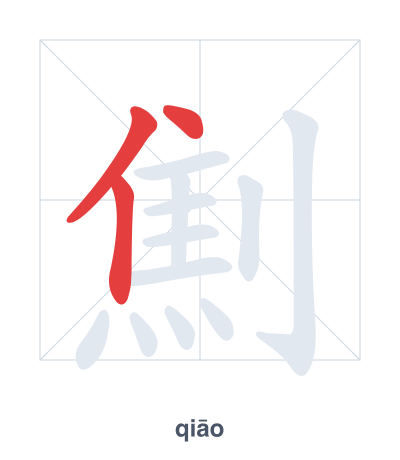
Open Hanzi Writer to see the animated stroke order and practice writing 劁 with real-time feedback.
The character 劁 (qiāo) is written with 14 strokes. Follow the standard Chinese stroke order: top to bottom, left to right, outside before inside. The radical 刂 is one of its key components.
Practice the correct stroke order with the Hanzi Writer app to see animated stroke-by-stroke guidance with real-time feedback.
劁 means castrate (livestock).
The character 劁 combines the radical 刂 (knife) on the right, representing the action of cutting, with the left component 焦 (meaning burnt or anxious) serving as a phonetic clue. Together, the knife suggests the surgical procedure of castration, where reproductive organs are removed.
💡 Memory Tip: Picture a farmer holding a sharp knife (刂) to quickly 'cauterize' (焦 like scorching) the livestock's reproductive parts.
农民在劁猪。
nóng mín zài qiāo zhū
The farmer is castrating pigs.
他在山上劁草。
tā zài shān shàng qiāo cǎo
He is cutting grass on the mountain.
他是一个老劁匠。
tā shì yí gè lǎo qiāo jiàng
He is an old livestock gelder.
Open Hanzi Writer to see the animated stroke order and practice writing 劁 with real-time feedback.
✨ Animated stroke order · Handwriting recognition · HSK-graded practice · Free to use
劁 is composed of the left part 焦 (qiáo, meaning burnt) which provides the sound, and the right radical 刂 (knife) which indicates cutting. Since castration involves using a knife, the knife radical directly relates to the action. The left part 焦 may suggest the use of heated tools in traditional practice.