劂 (jué) means "carving tool" in Chinese. It has 14 strokes with the radical 刂.
Rated 3.9/5 in difficulty (challenging).
Appears in 3+ common words including 剞劂 (jī jué), 劂刀 (jué dāo), 雕劂 (diāo jué).
Due to its 14 strokes, Hanzi Writer's error detection shows 劂 requires focused practice — most learners need 10+ attempts for consistent accuracy.
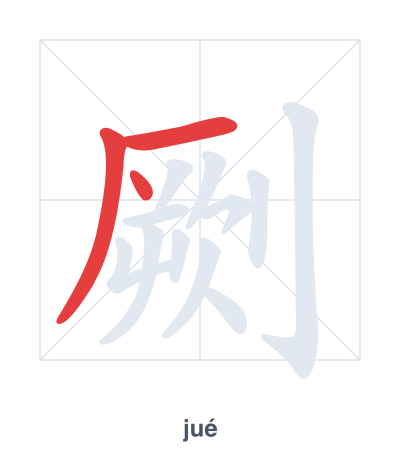
Open Hanzi Writer to see the animated stroke order and practice writing 劂 with real-time feedback.
The character 劂 (jué) is written with 14 strokes. Follow the standard Chinese stroke order: top to bottom, left to right, outside before inside. The radical 刂 is one of its key components.
Practice the correct stroke order with the Hanzi Writer app to see animated stroke-by-stroke guidance with real-time feedback.
劂 means carving tool.
劂 is a compound character where the left component 厥 (jué) primarily provides the phonetic clue, while the right radical 刂 (knife) indicates it is a cutting or carving tool. The character 厥 itself originally depicted a person with a tool or a pile of stones, but in this combination, it contributes to the sound and may hint at the action of carving.
💡 Memory Tip: Imagine a carving tool (刂) slicing through a cliff side (厂) where a sprout (屮) grows and a mouth (欠) yawns—a vivid scene of sculpting life from stone.
这本书已经剞劂了。
zhè běn shū yǐ jīng jī jué le
This book has already been printed.
他用劂刀刻字。
tā yòng jué dāo kè zì
He carved characters with a carving knife.
这种雕劂很精美。
zhè zhǒng diāo jué hěn jīng měi
This carving is very exquisite.
Open Hanzi Writer to see the animated stroke order and practice writing 劂 with real-time feedback.
✨ Animated stroke order · Handwriting recognition · HSK-graded practice · Free to use
The character is composed of two parts: the left side 厥 (jué) provides the pronunciation, and the right side 刂 (knife radical) indicates its connection to cutting or carving. The knife radical shows that this character relates to tools used for cutting, while the phonetic part 厥 gives the sound jué.