移 (yí) means "to move; to shift" in Chinese. It has 11 strokes with the radical 禾, and is HSK Level 4.
Rated 4.2/5 in difficulty (advanced).
Harder than 82% of HSK Level 4 characters.
Appears in 3+ common words including 移动 (yí dòng), 移开 (yí kāi), 移民 (yí mín).
Due to its 11 strokes, Hanzi Writer's error detection shows 移 requires focused practice — most learners need 10+ attempts for consistent accuracy.
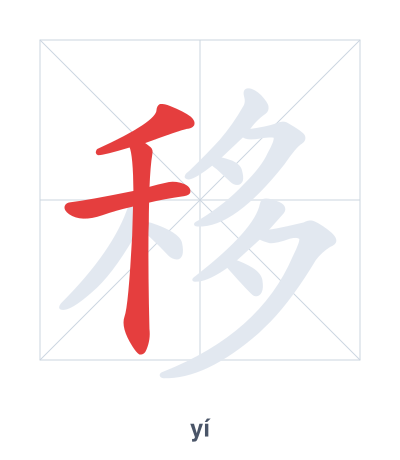
Open Hanzi Writer to see the animated stroke order and practice writing 移 with real-time feedback.
The character 移 (yí) is written with 11 strokes. Follow the standard Chinese stroke order: top to bottom, left to right, outside before inside. The radical 禾 is one of its key components.
Practice the correct stroke order with the Hanzi Writer app to see animated stroke-by-stroke guidance with real-time feedback.
移 means to move; to shift.
As an HSK Level 4 character, 移 is an intermediate-level character.
The character 移 combines the radical 禾 (grain) with 多 (many), reflecting the agricultural practice of transplanting many rice seedlings—moving them from a nursery to a field. This visual connection between grain and abundance illustrates the original meaning 'to move or shift' crops.
💡 Memory Tip: Picture a farmer carrying many (多) sheaves of grain (禾) as he moves them to a new field.
手机可以移动。
shǒu jī kě yǐ yí dòng
Mobile phones are portable.
请把椅子移开。
qǐng bǎ yǐ zi yí kāi
Please move the chair away.
他想移民去国外。
tā xiǎng yí mín qù guó wài
He wants to emigrate abroad.
Open Hanzi Writer to see the animated stroke order and practice writing 移 with real-time feedback.
✨ Animated stroke order · Handwriting recognition · HSK-graded practice · Free to use
The character 移 has the radical 禾 (grain) on the left and 多 (many) on the right. This combination suggests moving many grains from one place to another, which reflects the core meaning of "to move" or "to shift." The radical 禾 links the character to agriculture, while 多 emphasizes the quantity being moved.