民 (mín) means "people / citizens" in Chinese. It has 5 strokes with the radical 氏, and is HSK Level 3.
Rated 2.7/5 in difficulty (moderate).
Harder than 13% of HSK Level 3 characters.
Appears in 3+ common words including 人民 (rén mín), 农民 (nóng mín), 民用 (mín yòng).
Hanzi Writer's stroke validation shows learners typically need 5-8 attempts to write 民 with correct proportion and order.
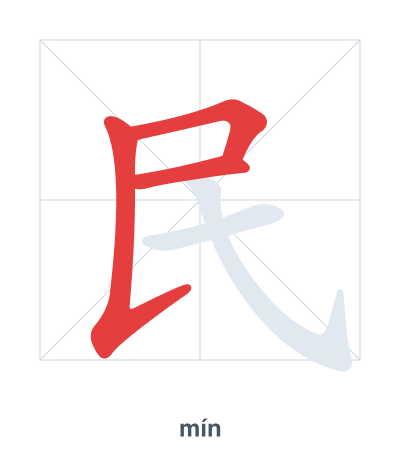
Open Hanzi Writer to see the animated stroke order and practice writing 民 with real-time feedback.
The character 民 (mín) is written with 5 strokes. Follow the standard Chinese stroke order: top to bottom, left to right, outside before inside. The radical 氏 is one of its key components.
Practice the correct stroke order with the Hanzi Writer app to see animated stroke-by-stroke guidance with real-time feedback.
民 means people / citizens.
As an HSK Level 3 character, 民 is an intermediate-level character.
The ancient form of 民 depicts an eye with a needle or tool piercing it, symbolizing a blinded captive or slave, which later extended to mean 'people' or 'subjects' under authority. The modern shape retains the radical 氏 (clan) with a horizontal stroke, hinting at the common populace tied to a lineage.
💡 Memory Tip: Picture a citizen (民) with a wide flat hat (top horizontal) and a curved walking stick (bottom hook) strolling through the town square.
我们为人民服务。
wǒ men wéi rén mín fú wù
We serve the people.
那个农民在种地。
nà ge nóng mín zài zhòng dì
That farmer is farming the land.
这是民用机场。
zhè shì mín yòng jī chǎng
This is a civil airport.
Open Hanzi Writer to see the animated stroke order and practice writing 民 with real-time feedback.
✨ Animated stroke order · Handwriting recognition · HSK-graded practice · Free to use
The character 民 originally depicted an eye pierced with a needle, symbolizing a captive or enslaved person. Over time, it evolved to represent "people" or "citizens" in a broader sense. The radical 氏 (clan) hints at lineage, while the overall form suggests a group of common people.