疑 (yí) means "To doubt; to suspect; question" in Chinese. It has 14 strokes with the radical 疋, and is HSK Level 4.
Rated 4.2/5 in difficulty (advanced).
Harder than 80% of HSK Level 4 characters.
Appears in 3+ common words including 疑问 (yí wèn), 怀疑 (huái yí), 疑心 (yí xīn).
Due to its 14 strokes, Hanzi Writer's error detection shows 疑 requires focused practice — most learners need 10+ attempts for consistent accuracy.
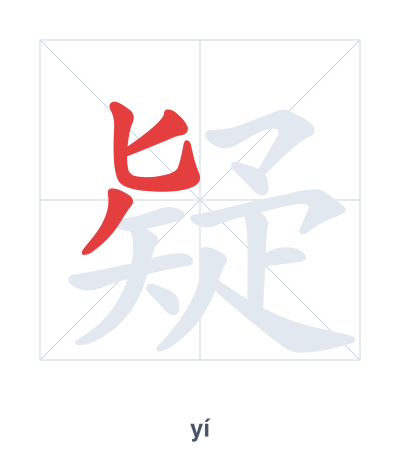
Open Hanzi Writer to see the animated stroke order and practice writing 疑 with real-time feedback.
The character 疑 (yí) is written with 14 strokes. Follow the standard Chinese stroke order: top to bottom, left to right, outside before inside. The radical 疋 is one of its key components.
Practice the correct stroke order with the Hanzi Writer app to see animated stroke-by-stroke guidance with real-time feedback.
疑 means To doubt; to suspect; question.
As an HSK Level 4 character, 疑 is an intermediate-level character.
The character 疑 combines a spoon (匕) and an arrow (矢) with a foot (疋), depicting a person standing still, puzzled by mismatched objects — this visual dissonance expresses hesitation and doubt. Its ancient form showed a figure with a staff, glancing left and right in uncertainty.
💡 Memory Tip: Picture a footprint (疋) beside a spoon (匕) and an arrow (矢) — such an odd trio makes you doubt what really happened there.
我有一个疑问。
wǒ yǒu yí gè yí wèn
I have a doubt.
我怀疑他在骗我。
wǒ huái yí tā zài piàn wǒ
I suspect he is deceiving me.
他的疑心很重。
tā de yí xīn hěn zhòng
He is very suspicious.
Open Hanzi Writer to see the animated stroke order and practice writing 疑 with real-time feedback.
✨ Animated stroke order · Handwriting recognition · HSK-graded practice · Free to use
The top left part 匕 means "spoon" or "dagger," but in this character it suggests something sharp or dangerous. The right side 矢 means "arrow," and the bottom part 疋 means "foot" or "leg." Together, they create an image of confusion or uncertainty, like an arrow that misses its target or a path you cannot follow, which leads to doubt.