扬 (yáng) means "to raise; to hoist; to spread" in Chinese. It has 6 strokes with the radical 扌, and is HSK Level 4.
Rated 3.2/5 in difficulty (challenging).
Harder than 21% of HSK Level 4 characters.
Appears in 3+ common words including 表扬 (biǎo yáng), 发扬 (fā yáng), 扬名 (yáng míng).
Due to its 6 strokes, Hanzi Writer's error detection shows 扬 requires focused practice — most learners need 10+ attempts for consistent accuracy.
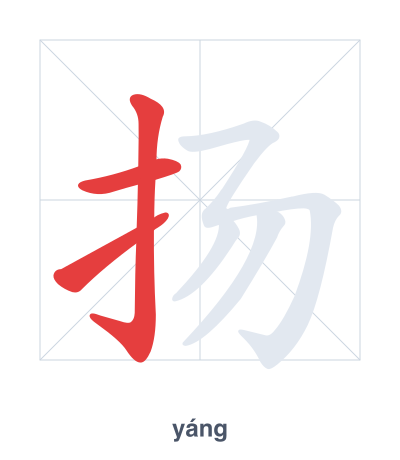
Open Hanzi Writer to see the animated stroke order and practice writing 扬 with real-time feedback.
The character 扬 (yáng) is written with 6 strokes. Follow the standard Chinese stroke order: top to bottom, left to right, outside before inside. The radical 扌 is one of its key components.
Practice the correct stroke order with the Hanzi Writer app to see animated stroke-by-stroke guidance with real-time feedback.
扬 means to raise; to hoist; to spread.
As an HSK Level 4 character, 扬 is an intermediate-level character.
扬 combines the hand radical 扌 with 昜 (yáng), a phonetic component that originally depicted the sun rising. The hand's action of lifting or hoisting something upward mirrors the sun's ascent, giving the character its meanings of 'to raise' or 'to spread.'
💡 Memory Tip: Picture a hand (扌) hoisting a bright sun (the 日 inside 昜) up into the sky, spreading its light everywhere.
老师表扬了我。
lǎo shī biǎo yáng le wǒ
The teacher praised me.
我们要发扬优点。
wǒ men yào fā yáng yōu diǎn
We should promote our strengths.
他在比赛中扬名。
tā zài bǐ sài zhōng yáng míng
He became famous in the competition.
Open Hanzi Writer to see the animated stroke order and practice writing 扬 with real-time feedback.
✨ Animated stroke order · Handwriting recognition · HSK-graded practice · Free to use
The left side is 扌, a radical meaning "hand," and the right side is 昜, which originally depicted the sun rising. Together, they suggest using your hand to lift something upward or spread it out, like raising a flag or spreading news.