馍 (mó) means "steamed bun" in Chinese. It has 13 strokes with the radical 饣.
Rated 4.2/5 in difficulty (advanced).
Appears in 3+ common words including 肉夹馍 (ròu jiā mó), 馒头馍 (mán tou mó), 泡馍 (pào mó).
Due to its 13 strokes, Hanzi Writer's error detection shows 馍 requires focused practice — most learners need 10+ attempts for consistent accuracy.
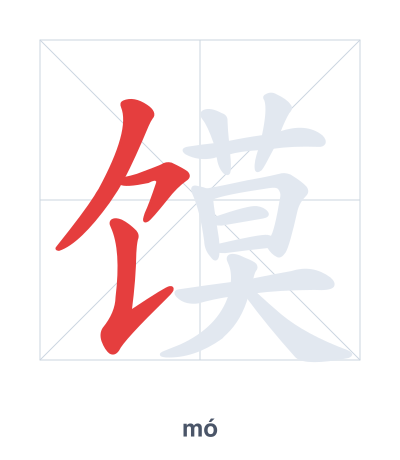
Open Hanzi Writer to see the animated stroke order and practice writing 馍 with real-time feedback.
The character 馍 (mó) is written with 13 strokes. Follow the standard Chinese stroke order: top to bottom, left to right, outside before inside. The radical 饣 is one of its key components.
Practice the correct stroke order with the Hanzi Writer app to see animated stroke-by-stroke guidance with real-time feedback.
馍 means steamed bun.
馍 is a phono-semantic compound. The radical 饣 (meaning food) indicates it is edible, while the component 莫 (mò) provides the pronunciation. Together they form the character for a steamed bun, a staple food in northern China.
💡 Memory Tip: Imagine a steamed bun (饣) with a face that looks like 莫 saying 'Don't eat me!'—but you take a big bite anyway.
我想吃肉夹馍。
wǒ xiǎng chī ròu jiā mó
I want to eat Roujiamo (Chinese hamburger).
这种馒头馍很软。
zhè zhǒng mán tou mó hěn ruǎn
This kind of steamed bun is very soft.
羊肉泡馍很有名。
yáng ròu pào mó hěn yǒu míng
Mutton Paomo (steamed bread soaked in mutton soup) is very famous.
Open Hanzi Writer to see the animated stroke order and practice writing 馍 with real-time feedback.
✨ Animated stroke order · Handwriting recognition · HSK-graded practice · Free to use
The character 馍 is made of two parts: the left radical 饣 (food) and the right part 莫. The radical 饣 indicates that 馍 relates to food, while 莫 provides the pronunciation (mó) and also suggests the idea of something wrapped or covered. Together, they create the meaning of a steamed bun, a type of food that is wrapped or shaped.