馏 (liú) means "to reheat by steaming" in Chinese. It has 13 strokes with the radical 饣.
Rated 4.2/5 in difficulty (advanced).
Appears in 3+ common words including 馏饭 (liú fàn), 馏馒头 (liú mán tou), 蒸馏 (zhēng liú).
Due to its 13 strokes, Hanzi Writer's error detection shows 馏 requires focused practice — most learners need 10+ attempts for consistent accuracy.
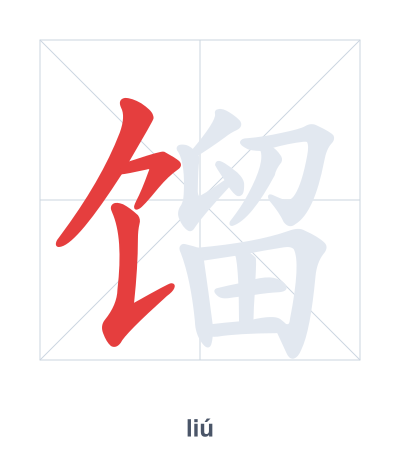
Open Hanzi Writer to see the animated stroke order and practice writing 馏 with real-time feedback.
The character 馏 (liú) is written with 13 strokes. Follow the standard Chinese stroke order: top to bottom, left to right, outside before inside. The radical 饣 is one of its key components.
Practice the correct stroke order with the Hanzi Writer app to see animated stroke-by-stroke guidance with real-time feedback.
馏 means to reheat by steaming.
The character 馏 combines the food radical 饣 (simplified from 食) with 留, which means 'to stay' or 'to remain' and also provides the pronunciation. Together, they suggest food (饣) that is kept (留) and then reheated by steaming, as leftover dishes are often steamed again to warm them.
💡 Memory Tip: Picture leftover food (饣) that's been kept (留) in the fridge and then placed in a steamer basket (resembling the upper part of 馏) to be reheated.
妈妈在馏饭。
mā mā zài liú fàn
Mom is reheating the rice by steaming.
把馒头馏一下。
bǎ mán tou liú yī xià
Reheat the steamed buns by steaming.
这是蒸馏水。
zhè shì zhēng liú shuǐ
This is distilled water.
Open Hanzi Writer to see the animated stroke order and practice writing 馏 with real-time feedback.
✨ Animated stroke order · Handwriting recognition · HSK-graded practice · Free to use
The left side is 饣, the food radical, showing the character relates to food or eating. The right side is 留 (liú, to stay or remain), which gives a hint about the pronunciation and also suggests keeping food warm through steaming. Together, they mean reheating food by steaming, keeping it warm.