馐 (xiū) means "delicacy" in Chinese. It has 13 strokes with the radical 饣.
Rated 4.2/5 in difficulty (advanced).
Appears in 3+ common words including 珍馐 (zhēn xiū), 馐馔 (xiū zhuàn), 珍馐美馔 (zhēn xiū měi zhuàn).
Due to its 13 strokes, Hanzi Writer's error detection shows 馐 requires focused practice — most learners need 10+ attempts for consistent accuracy.
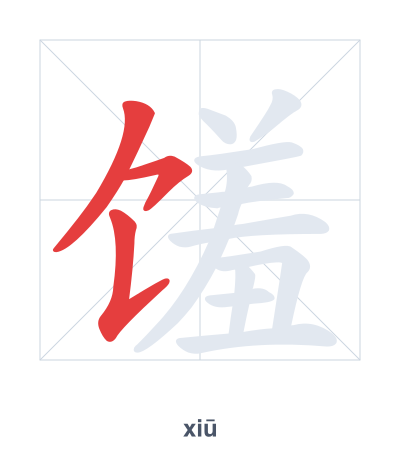
Open Hanzi Writer to see the animated stroke order and practice writing 馐 with real-time feedback.
The character 馐 (xiū) is written with 13 strokes. Follow the standard Chinese stroke order: top to bottom, left to right, outside before inside. The radical 饣 is one of its key components.
Practice the correct stroke order with the Hanzi Writer app to see animated stroke-by-stroke guidance with real-time feedback.
馐 means delicacy.
The left radical 饣 (food) indicates the category of edible items, while the right component 羞 (xiū) originally showed a hand holding a sheep for offering—together they depict specially presented or prepared food, hence a delicacy.
💡 Memory Tip: Picture a chef (饣) proudly presenting a plate of roasted lamb (the sheep under the hand in 羞) as the finest delicacy of the feast.
桌上全是珍馐。
zhuō shàng quán shì zhēn xiū
The table is full of delicacies.
这里的馐馔很精美。
zhè lǐ de xiū zhuàn hěn jīng měi
The delicacies here are very exquisite.
准备了珍馐美馔。
zhǔn bèi le zhēn xiū měi zhuàn
Prepared a feast of delicacies.
Open Hanzi Writer to see the animated stroke order and practice writing 馐 with real-time feedback.
✨ Animated stroke order · Handwriting recognition · HSK-graded practice · Free to use
馐 is composed of the radical 饣 (food) on the left and 羞 on the right. 羞 originally meant "to offer food" and also implies something fine, so together they form the idea of "delicacy" or "fine food." The 饣 radical clearly links it to edible items.