谳 (yàn) means "to decide a case; verdict" in Chinese. It has 15 strokes with the radical 讠.
Rated 3.9/5 in difficulty (challenging).
Appears in 3+ common words including 审谳 (shěn yàn), 谳语 (yàn yǔ), 定谳 (dìng yàn).
Due to its 15 strokes, Hanzi Writer's error detection shows 谳 requires focused practice — most learners need 10+ attempts for consistent accuracy.
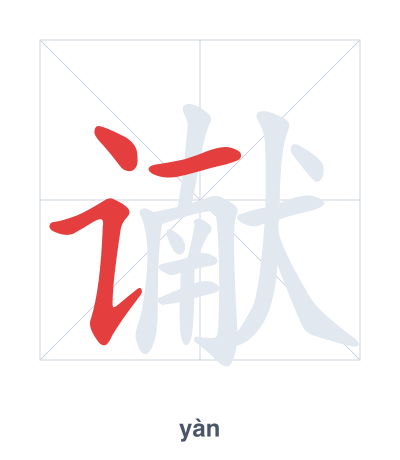
Open Hanzi Writer to see the animated stroke order and practice writing 谳 with real-time feedback.
The character 谳 (yàn) is written with 15 strokes. Follow the standard Chinese stroke order: top to bottom, left to right, outside before inside. The radical 讠 is one of its key components.
Practice the correct stroke order with the Hanzi Writer app to see animated stroke-by-stroke guidance with real-time feedback.
谳 means to decide a case; verdict.
This character combines the speech radical 讠 (words) with 献 (to offer). In ancient judicial practice, the judge would verbally present (讠) the final verdict as an offering (献) of justice, hence the meaning 'to decide a case' or 'verdict'.
💡 Memory Tip: Picture a judge speaking (讠) as he offers (献) a scroll with the verdict — the words are the final decision.
法官正在进行审谳。
fǎ guān zhèng zài jìn xíng shěn yàn
The judge is reviewing the case for a final verdict.
这是最后的谳语。
zhè shì zuì hòu de yàn yǔ
This is the final verdict.
这个案件已经定谳。
zhè ge àn jiàn yǐ jīng dìng yàn
This case has reached a final verdict.
Open Hanzi Writer to see the animated stroke order and practice writing 谳 with real-time feedback.
✨ Animated stroke order · Handwriting recognition · HSK-graded practice · Free to use
The character 谳 is composed of the radical 讠 (speech) on the left and 献 (to offer or sacrifice) on the right. The speech radical connects to the verbal process of a trial, while 献 suggests presenting evidence or a case. Together, they form the idea of formally deciding a case through spoken judgment.