谩 (mán/màn) means "to deceive; to insult" in Chinese. It has 13 strokes with the radical 讠.
Rated 3.9/5 in difficulty (challenging).
Appears in 3+ common words including 谩骂 (màn mà), 谩辞 (mán cí), 谩语 (mán yǔ).
Due to its 13 strokes, Hanzi Writer's error detection shows 谩 requires focused practice — most learners need 10+ attempts for consistent accuracy.
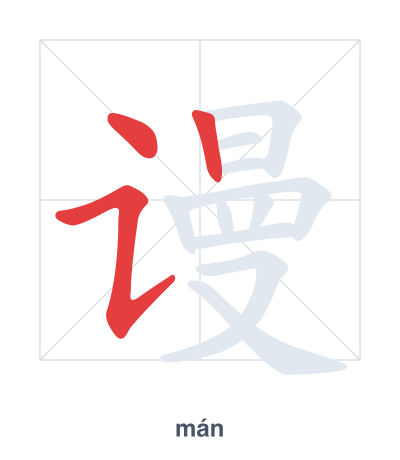
Open Hanzi Writer to see the animated stroke order and practice writing 谩 with real-time feedback.
The character 谩 (mán/màn) is written with 13 strokes. Follow the standard Chinese stroke order: top to bottom, left to right, outside before inside. The radical 讠 is one of its key components.
Practice the correct stroke order with the Hanzi Writer app to see animated stroke-by-stroke guidance with real-time feedback.
谩 means to deceive; to insult.
This is a polyphonic character with readings: mán, màn.
The character 谩 combines the speech radical 讠 (words) with 曼 (màn, meaning 'extended' or 'prolonged'). In ancient usage, 曼 originally depicted a hand covering an eye, implying concealment or stretching the truth—so 谩 suggests speech that is drawn out or twisted to deceive or insult.
💡 Memory Tip: Picture a smooth-talking man (曼) using words (讠) to stretch the truth and insult a friend.
不要随意谩骂。
bú yào suí yì màn mà
Don't hurl insults at will.
这种谩辞很难听。
zhè zhǒng mán cí hěn nán tīng
These abusive words are very unpleasant.
他正在说谩语。
tā zhèng zài shuō mán yǔ
He is speaking abusively.
Open Hanzi Writer to see the animated stroke order and practice writing 谩 with real-time feedback.
✨ Animated stroke order · Handwriting recognition · HSK-graded practice · Free to use
谩 is made of two parts: the left side 讠 (speech radical) and the right side 曼 (màn, which provides the sound). The speech radical shows that the character relates to spoken language, while the whole character means 'to deceive' or 'to insult'—both actions done through words.