婿 (xù) means "Son-in-law; husband." in Chinese. It has 12 strokes with the radical 女, and is HSK Level 7.
Rated 4.2/5 in difficulty (advanced).
Harder than 51% of HSK Level 7 characters.
Appears in 3+ common words including 女婿 (nǚ xù), 夫婿 (fū xù), 妹婿 (mèi xù).
Due to its 12 strokes, Hanzi Writer's error detection shows 婿 requires focused practice — most learners need 10+ attempts for consistent accuracy.
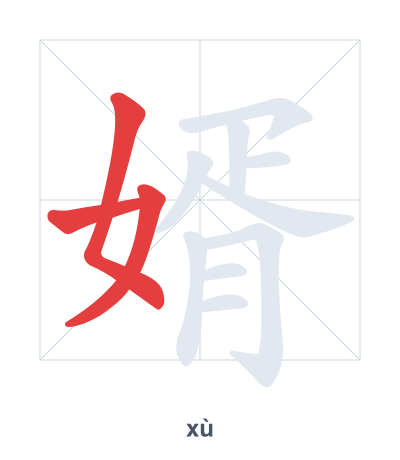
Open Hanzi Writer to see the animated stroke order and practice writing 婿 with real-time feedback.
The character 婿 (xù) is written with 12 strokes. Follow the standard Chinese stroke order: top to bottom, left to right, outside before inside. The radical 女 is one of its key components.
Practice the correct stroke order with the Hanzi Writer app to see animated stroke-by-stroke guidance with real-time feedback.
婿 means Son-in-law; husband..
As an HSK Level 7 character, 婿 is an intermediate-level character.
婿 combines the radical 女 (woman), indicating a family relation through marriage, with 胥 (xū), which originally depicted a footprint (止) over meat (月/肉) and later served phonetically, also hinting at the role of an assistant or official in the household. The character thus signifies a woman's husband or son-in-law, someone who becomes part of her family.
💡 Memory Tip: Picture a woman (女) watching her new son-in-law walking (止) under the moonlight (月) carrying a heavy load — that's 婿, the man who just joined the family.
他是我的女婿。
tā shì wǒ de nǚ xù
He is my son-in-law.
她的夫婿很帅。
tā de fū xù hěn shuài
Her husband is very handsome.
妹婿在公司工作。
mèi xù zài gōng sī gōng zuò
My younger sister's husband works at a company.
Open Hanzi Writer to see the animated stroke order and practice writing 婿 with real-time feedback.
✨ Animated stroke order · Handwriting recognition · HSK-graded practice · Free to use
The character 婿 is composed of the radical 女 (woman) on the left and the phonetic component 胥 (xū) on the right. The 女 radical connects the character to family relationships involving women, since a son-in-law is the husband of one's daughter. The right side 胥 provides the pronunciation and originally meant 'to wait' or 'a clerk,' but here it mainly functions as a sound hint.