墟 (xū) means "ruins" in Chinese. It has 14 strokes with the radical 土, and is HSK Level 7.
Rated 4.2/5 in difficulty (advanced).
Harder than 50% of HSK Level 7 characters.
Appears in 3+ common words including 废墟 (fèi xū), 殷墟 (yīn xū), 墟落 (xū luò).
Due to its 14 strokes, Hanzi Writer's error detection shows 墟 requires focused practice — most learners need 10+ attempts for consistent accuracy.
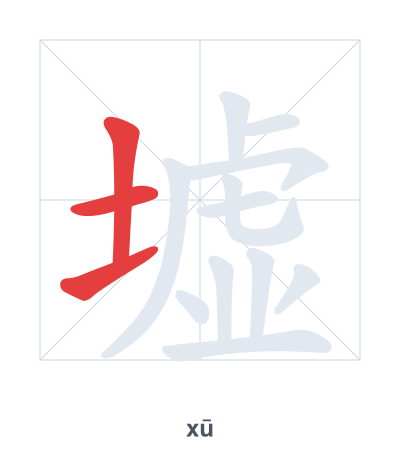
Open Hanzi Writer to see the animated stroke order and practice writing 墟 with real-time feedback.
The character 墟 (xū) is written with 14 strokes. Follow the standard Chinese stroke order: top to bottom, left to right, outside before inside. The radical 土 is one of its key components.
Practice the correct stroke order with the Hanzi Writer app to see animated stroke-by-stroke guidance with real-time feedback.
墟 means ruins.
As an HSK Level 7 character, 墟 is an intermediate-level character.
The character 墟 combines the radical 土 (earth) with the phonetic component 虚 (empty, void). It originally depicted a deserted site where human settlements once stood, now reduced to empty earth—literally 'earth that has become empty'.
💡 Memory Tip: Imagine a mound of earth (土) that was once a lively village, now completely empty (虚) and overgrown—that's the ruins of 墟.
这里以前是一片废墟。
zhè lǐ yǐ qián shì yī piàn fèi xū
This place used to be a pile of ruins.
殷墟在中国河南。
yīn xū zài zhōng guó hé nán
Yin Xu is located in Henan, China.
远处的墟落很安静。
yuǎn chù de xū luò hěn ān jìng
The distant village was very quiet.
Open Hanzi Writer to see the animated stroke order and practice writing 墟 with real-time feedback.
✨ Animated stroke order · Handwriting recognition · HSK-graded practice · Free to use
墟 is a left-right character. The left component is 土 (earth, soil), and the right component is 虚 (xū), which means empty or hollow. Together, they suggest a place where earth is empty — a ruin.