堞 (dié) means "battlement; crenelated wall" in Chinese. It has 12 strokes with the radical 土.
Rated 4.2/5 in difficulty (advanced).
Appears in 3+ common words including 城堞 (chéng dié), 雉堞 (zhì dié), 堞口 (dié kǒu).
Due to its 12 strokes, Hanzi Writer's error detection shows 堞 requires focused practice — most learners need 10+ attempts for consistent accuracy.
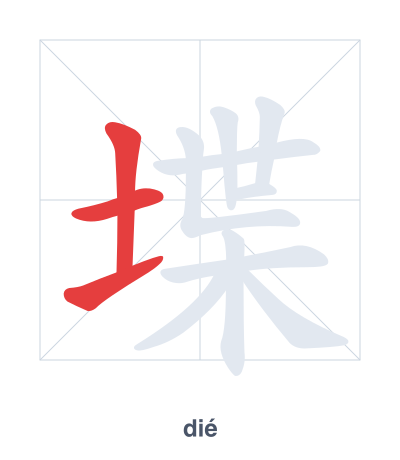
Open Hanzi Writer to see the animated stroke order and practice writing 堞 with real-time feedback.
The character 堞 (dié) is written with 12 strokes. Follow the standard Chinese stroke order: top to bottom, left to right, outside before inside. The radical 土 is one of its key components.
Practice the correct stroke order with the Hanzi Writer app to see animated stroke-by-stroke guidance with real-time feedback.
堞 means battlement; crenelated wall.
堞 combines the radical 土 (earth or wall) with 枼, which originally depicted a thin, flat piece of wood or leaf. Together, they suggest a wall made of earth with flat, projecting teeth—like the crenellations of a battlement. The character visually represents a fortified wall with alternating high and low sections.
💡 Memory Tip: Picture a wall of earth (土) topped with a row of flat, notched stones (枼) that soldiers peek through during battle.
城堞上站着士兵。
chéng dié shàng zhàn zhe shì bīng
Soldiers are standing on the battlements.
长城的雉堞很整齐。
cháng chéng de zhì dié hěn zhěng qí
The battlements of the Great Wall are very neat.
他从堞口向下看。
tā cóng dié kǒu xiàng xià kàn
He looked down from the battlement.
Open Hanzi Writer to see the animated stroke order and practice writing 堞 with real-time feedback.
✨ Animated stroke order · Handwriting recognition · HSK-graded practice · Free to use
堞 is made of two parts: the radical 土 on the left (meaning earth or soil) and the component 枼 on the right. The earth part shows that battlements were built from mud or earth, while 枼 provides the sound (dié) and hints at the thin, layered shape of crenellations.