堙 (yīn) means "to block; to bury; to mound" in Chinese. It has 12 strokes with the radical 土.
Rated 4.2/5 in difficulty (advanced).
Appears in 3+ common words including 堙没 (yīn mò), 堙塞 (yīn sāi), 堙灭 (yīn miè).
Due to its 12 strokes, Hanzi Writer's error detection shows 堙 requires focused practice — most learners need 10+ attempts for consistent accuracy.
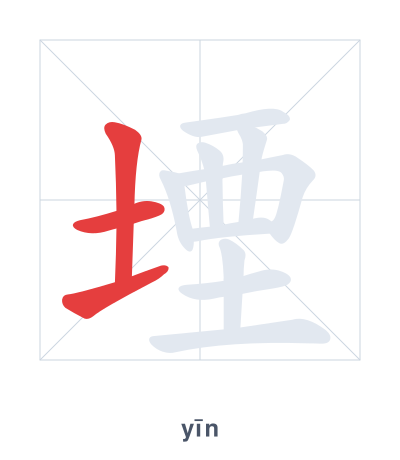
Open Hanzi Writer to see the animated stroke order and practice writing 堙 with real-time feedback.
The character 堙 (yīn) is written with 12 strokes. Follow the standard Chinese stroke order: top to bottom, left to right, outside before inside. The radical 土 is one of its key components.
Practice the correct stroke order with the Hanzi Writer app to see animated stroke-by-stroke guidance with real-time feedback.
堙 means to block; to bury; to mound.
堙 is a compound character combining the radical 土 (earth) and the component 垔 (yīn), which originally depicted a dam or barrier. Together, they convey the idea of blocking or burying something with earth, forming a mound or filling a gap.
💡 Memory Tip: Imagine a pile of earth (土) rising up to block a narrow passage (垔 looks like a wall with a gate sealed shut).
历史不该被堙没。
lì shǐ bù gāi bèi yīn mò
History should not be buried or forgotten.
这里的河道被堙塞了。
zhè lǐ de hé dào bèi yīn sāi le
The river channel here is blocked.
文明不会轻易堙灭。
wén míng bú huì qīng yì yīn miè
Civilization will not easily perish.
Open Hanzi Writer to see the animated stroke order and practice writing 堙 with real-time feedback.
✨ Animated stroke order · Handwriting recognition · HSK-graded practice · Free to use
堙 is made of two parts: the radical 土 (earth) on the left and the component 垔 on the right. The 垔 part itself contains 西 on top and another 土 at the bottom, and it gives the sound yīn while also suggesting the idea of "blocking" or "burying." Together, they show using earth to block or bury something.