邪 (xié) means "Evil / Wicked" in Chinese. It has 6 strokes with the radical 阝, and is HSK Level 7.
Rated 2.9/5 in difficulty (moderate).
Harder than 8% of HSK Level 7 characters.
Appears in 3+ common words including 邪恶 (xié è), 邪气 (xié qì), 歪门邪道 (wāi mén xié dào).
Hanzi Writer's stroke validation shows learners typically need 5-8 attempts to write 邪 with correct proportion and order.
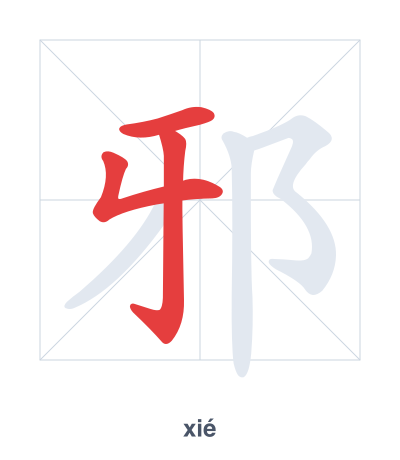
Open Hanzi Writer to see the animated stroke order and practice writing 邪 with real-time feedback.
The character 邪 (xié) is written with 6 strokes. Follow the standard Chinese stroke order: top to bottom, left to right, outside before inside. The radical 阝 is one of its key components.
Practice the correct stroke order with the Hanzi Writer app to see animated stroke-by-stroke guidance with real-time feedback.
邪 means Evil / Wicked.
As an HSK Level 7 character, 邪 is an intermediate-level character.
The character 邪 combines the radical 阝 (a hill or mound) with 牙 (a fang or tooth). Originally referring to a crooked or uneven place, the meaning shifted to 'evil' or 'wicked' through the association of twistedness and deviance.
💡 Memory Tip: Picture a crooked fang (牙) emerging from a hill (阝) as a symbol of hidden evil.
这是一个邪恶的人。
zhè shì yí gè xié è de rén
This is an evil person.
他身上有股邪气。
tā shēn shàng yǒu gǔ xié qì
He has a sinister air about him.
不要走歪门邪道。
bú yào zǒu wāi mén xié dào
Don't take the wrong path.
Open Hanzi Writer to see the animated stroke order and practice writing 邪 with real-time feedback.
✨ Animated stroke order · Handwriting recognition · HSK-graded practice · Free to use
邪 is made of the radical 阝 (on the left, meaning a hill or mound) and the component 牙 (yá, meaning tooth). The combination doesn't directly mean 'evil' through these parts, but some scholars see the crooked shape of a tooth as suggesting something twisted or wrong. The radical 阝 gives a sense of place, and the overall character has come to mean evil or wickedness.