斛 (hú) means "Hu (ancient dry measure)" in Chinese. It has 11 strokes with the radical 斗.
Rated 4.2/5 in difficulty (advanced).
Appears in 3+ common words including 石斛 (shí hú), 斛斗 (hú dòu), 斗斛 (dòu hú).
Due to its 11 strokes, Hanzi Writer's error detection shows 斛 requires focused practice — most learners need 10+ attempts for consistent accuracy.
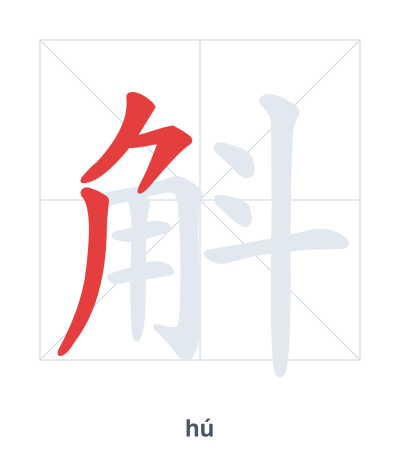
Open Hanzi Writer to see the animated stroke order and practice writing 斛 with real-time feedback.
The character 斛 (hú) is written with 11 strokes. Follow the standard Chinese stroke order: top to bottom, left to right, outside before inside. The radical 斗 is one of its key components.
Practice the correct stroke order with the Hanzi Writer app to see animated stroke-by-stroke guidance with real-time feedback.
斛 means Hu (ancient dry measure).
| Character | 斛 |
| Pinyin | hú (hu) |
| Meaning | Hu (ancient dry measure) |
| Strokes | 11 |
| Radical | 斗 |
| Difficulty | 4.2/5 |
斛 combines the radical 斗 (dipper/measure) with 角 (horn), originally depicting a measuring vessel made from a horn or shaped like one, used to measure grain in ancient China.
💡 Memory Tip: Picture a horn (角) pouring grain into a dipper (斗) to measure exactly one hu.
他买了一些石斛。
tā mǎi le yī xiē shí hú
He bought some dendrobium.
这是古代的斛斗。
zhè shì gǔ dài de hú dòu
These are ancient dry measures.
斗斛是古代量器。
dòu hú shì gǔ dài liáng qì
Dou and Hu are ancient measuring tools.
Open Hanzi Writer to see the animated stroke order and practice writing 斛 with real-time feedback.
✨ Animated stroke order · Handwriting recognition · HSK-graded practice · Free to use
斛 is composed of two parts: the left side is 角 (jiǎo, horn or angle), and the right side is the radical 斗 (dǒu, a dipper or measure). Together, they suggest a container used for measuring grain, specifically a ‘hu’ — an ancient dry measure for volume.