携 (xié) means "carry / bring along" in Chinese. It has 13 strokes with the radical 扌, and is HSK Level 7.
Rated 4.2/5 in difficulty (advanced).
Harder than 60% of HSK Level 7 characters.
Appears in 3+ common words including 携带 (xié dài), 携手 (xié shǒu), 提携 (tí xié).
Due to its 13 strokes, Hanzi Writer's error detection shows 携 requires focused practice — most learners need 10+ attempts for consistent accuracy.
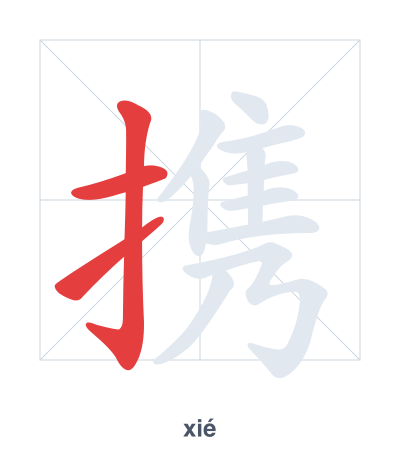
Open Hanzi Writer to see the animated stroke order and practice writing 携 with real-time feedback.
The character 携 (xié) is written with 13 strokes. Follow the standard Chinese stroke order: top to bottom, left to right, outside before inside. The radical 扌 is one of its key components.
Practice the correct stroke order with the Hanzi Writer app to see animated stroke-by-stroke guidance with real-time feedback.
携 means carry / bring along.
As an HSK Level 7 character, 携 is an intermediate-level character.
The character 携 combines the hand radical 扌 with 隽, where 隽 originally depicts a hand (彐) grasping a bird (隹), reinforcing the act of holding or carrying something. Together, they represent the action of bringing or transporting an object along with one's hand.
💡 Memory Tip: Picture your hand (扌) grabbing a talented friend (隽) and carrying them along to a party.
请携带好随身物品。
qǐng xié dài hǎo suí shēn wù pǐn
Please take your personal belongings with you.
我们携手合作。
wǒ men xié shǒu hé zuò
We are working hand in hand.
谢谢老师的提携。
xiè xiè lǎo shī de tí xié
Thank you, teacher, for your guidance and support.
Open Hanzi Writer to see the animated stroke order and practice writing 携 with real-time feedback.
✨ Animated stroke order · Handwriting recognition · HSK-graded practice · Free to use
携 is made of the hand radical 扌 on the left, showing the action involves the hand, and the phonetic component 隽 on the right. The hand radical tells you the character is about hand actions like carrying or bringing along, while 隽 gives the sound xié.