带 (dài) means "To bring; belt; ribbon." in Chinese. It has 9 strokes with the radical 巾, and is HSK Level 2.
Rated 3.5/5 in difficulty (challenging).
Harder than 61% of HSK Level 2 characters.
Appears in 3+ common words including 带来 (dài lái), 皮带 (pí dài), 热带 (rè dài).
Due to its 9 strokes, Hanzi Writer's error detection shows 带 requires focused practice — most learners need 10+ attempts for consistent accuracy.
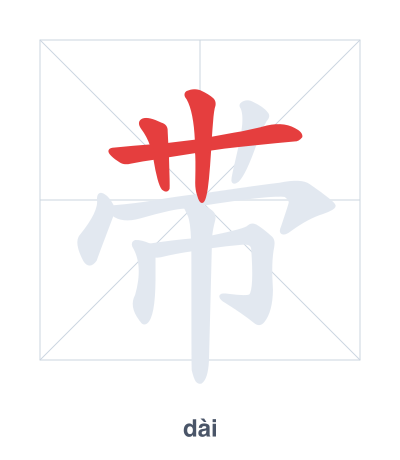
Open Hanzi Writer to see the animated stroke order and practice writing 带 with real-time feedback.
The character 带 (dài) is written with 9 strokes. Follow the standard Chinese stroke order: top to bottom, left to right, outside before inside. The radical 巾 is one of its key components.
Practice the correct stroke order with the Hanzi Writer app to see animated stroke-by-stroke guidance with real-time feedback.
带 means To bring; belt; ribbon..
As an HSK Level 2 character, 带 is among the first characters beginners learn.
Originally a pictograph of a belt with hanging ornaments, later combined with the cloth radical 巾 to emphasize material. The modern form retains 巾 at the bottom and a simplified top representing the belt's loops and tie.
💡 Memory Tip: Picture a cloth belt (巾) with a big fancy buckle shaped like 艹 on top that you use to bring your belongings.
他今天带来了一本非常有意思的科幻小说。
tā jīn tiān dài lái le yī běn fēi cháng yǒu yì si de kē huàn xiǎo shuō 。
He brought a very interesting science fiction novel today.
他的皮带是黑色的。
tā de pí dài shì hēi sè de
His belt is black.
这里是热带地区。
zhè lǐ shì rè dài dì qū
This is a tropical region.
Open Hanzi Writer to see the animated stroke order and practice writing 带 with real-time feedback.
✨ Animated stroke order · Handwriting recognition · HSK-graded practice · Free to use
The character 带 has a top part that looks like a strap or sash, and the radical 巾 (cloth) at the bottom. This shows that it relates to cloth items used for tying or carrying, such as belts and ribbons. Together, the structure suggests something that binds or brings along.