仙 (xiān) means "Immortal; fairy" in Chinese. It has 5 strokes with the radical 亻, and is HSK Level 7.
Rated 2.7/5 in difficulty (moderate).
Harder than 3% of HSK Level 7 characters.
Appears in 3+ common words including 神仙 (shén xiān), 仙人掌 (xiān rén zhǎng), 仙女 (xiān nǚ).
Hanzi Writer's stroke validation shows learners typically need 5-8 attempts to write 仙 with correct proportion and order.
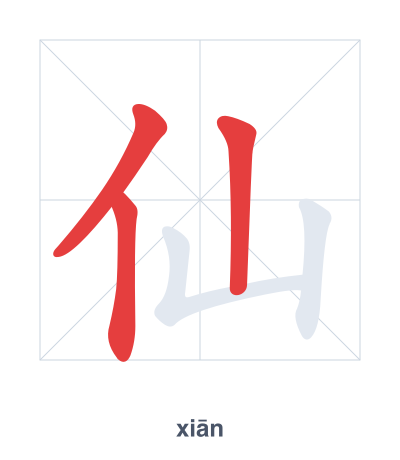
Open Hanzi Writer to see the animated stroke order and practice writing 仙 with real-time feedback.
The character 仙 (xiān) is written with 5 strokes. Follow the standard Chinese stroke order: top to bottom, left to right, outside before inside. The radical 亻 is one of its key components.
Practice the correct stroke order with the Hanzi Writer app to see animated stroke-by-stroke guidance with real-time feedback.
仙 means Immortal; fairy.
As an HSK Level 7 character, 仙 is an intermediate-level character.
仙 combines the radical 亻 (person) with 山 (mountain), suggesting a person dwelling in the mountains—a place traditionally associated with divine beings and immortality in Chinese folklore.
💡 Memory Tip: Picture a person (亻) living alone atop a mountain (山), evolving into a mystical immortal (仙) through centuries of meditation.
传说山上有神仙。
chuán shuō shān shàng yǒu shén xiān
Legend says there are immortals living on the mountain.
阳台上有一盆仙人掌。
yáng tái shàng yǒu yī pén xiān rén zhǎng
There is a pot of cactus on the balcony.
她长得像仙女一样。
tā zhǎng dé xiàng xiān nǚ yī yàng
She looks like a fairy.
Open Hanzi Writer to see the animated stroke order and practice writing 仙 with real-time feedback.
✨ Animated stroke order · Handwriting recognition · HSK-graded practice · Free to use
The character 仙 combines the radical 亻 (person) on the left with 山 (mountain) on the right. This suggests a person who lives in the mountains, which in Chinese mythology is where immortals and fairies reside. Thus, the structure directly reflects the meaning of 'immortal' or 'fairy'.