睘 (qióng) means "To look around; solitary." in Chinese. It has 13 strokes with the radical 目.
Rated 3.9/5 in difficulty (challenging).
Appears in 3+ common words including 睘睘 (qióng qióng), 睘视 (qióng shì), 睘然 (qióng rán).
Due to its 13 strokes, Hanzi Writer's error detection shows 睘 requires focused practice — most learners need 10+ attempts for consistent accuracy.
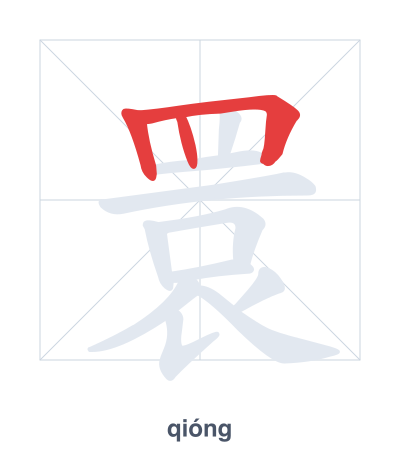
Open Hanzi Writer to see the animated stroke order and practice writing 睘 with real-time feedback.
The character 睘 (qióng) is written with 13 strokes. Follow the standard Chinese stroke order: top to bottom, left to right, outside before inside. The radical 目 is one of its key components.
Practice the correct stroke order with the Hanzi Writer app to see animated stroke-by-stroke guidance with real-time feedback.
睘 means To look around; solitary..
睘 depicts an eye (目) encircled by swirling lines in its ancient form, symbolizing the act of looking around in all directions. This meaning of 'to look around' later extended to 'solitary,' as one who looks around finds themselves alone.
💡 Memory Tip: Picture a solitary eye (目) wrapped in a circular cloak (the bottom part resembling 衣 with a ring), scanning an empty horizon for companionship.
他睘睘一人在走。
tā qióng qióng yī rén zài zǒu
He is walking all alone.
他睘视四周的风景。
tā qióng shì sì zhōu de fēng jǐng
He looked around at the surrounding scenery.
睘然独立的姿态。
qióng rán dú lì de zī tài
A solitary and independent posture.
Open Hanzi Writer to see the animated stroke order and practice writing 睘 with real-time feedback.
✨ Animated stroke order · Handwriting recognition · HSK-graded practice · Free to use
睘 is composed of the radical 目 (eye) on top and the phonetic component 袁 (yuán) below. The eye radical directly connects to the meaning 'to look around', while the phonetic part hints at the pronunciation qióng. The solitary meaning comes from classical usage, not directly from the components.