睛 (jīng) means "Eye; eyeball." in Chinese. It has 13 strokes with the radical 目, and is HSK Level 2.
Rated 3.7/5 in difficulty (challenging).
Harder than 87% of HSK Level 2 characters.
Appears in 3+ common words including 眼睛 (yǎn jīng), 眨眼睛 (zhǎ yǎn jīng), 画龙点睛 (huà lóng diǎn jīng).
Due to its 13 strokes, Hanzi Writer's error detection shows 睛 requires focused practice — most learners need 10+ attempts for consistent accuracy.
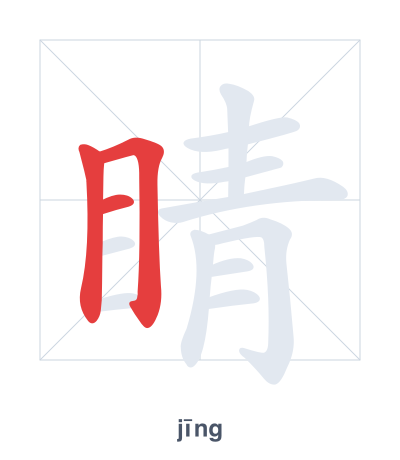
Open Hanzi Writer to see the animated stroke order and practice writing 睛 with real-time feedback.
The character 睛 (jīng) is written with 13 strokes. Follow the standard Chinese stroke order: top to bottom, left to right, outside before inside. The radical 目 is one of its key components.
Practice the correct stroke order with the Hanzi Writer app to see animated stroke-by-stroke guidance with real-time feedback.
睛 means Eye; eyeball..
As an HSK Level 2 character, 睛 is among the first characters beginners learn.
睛 is a phono-semantic compound character. The left component 目 (eye) indicates the meaning relates to the eye, while the right component 青 (qīng, meaning 'blue' or 'clear') provides the sound. Together, they form the word for 'eyeball'.
💡 Memory Tip: Imagine your eye (目) looking at a clear blue sky (青) — that sharp, clear vision comes from your eyeball (睛).
他的眼睛很大。
tā de yǎn jīng hěn dà
His eyes are very large.
别一直眨眼睛。
bié yì zhí zhǎ yǎn jīng
Don't keep blinking your eyes.
老师的话画龙点睛。
lǎo shī de huà huà lóng diǎn jīng
The teacher's words added the finishing touch.
Open Hanzi Writer to see the animated stroke order and practice writing 睛 with real-time feedback.
✨ Animated stroke order · Handwriting recognition · HSK-graded practice · Free to use
睛 is composed of two parts: the left radical 目, meaning 'eye,' and the right component 青, which provides sound. Since 目 directly relates to the eye, 睛 specifically refers to the eyeball or the eye itself.