睚 (yá) means "Eye socket; to stare." in Chinese. It has 13 strokes with the radical 目.
Rated 4.2/5 in difficulty (advanced).
Appears in 3+ common words including 睚眦 (yá zì), 睚眦必报 (yá zì bì bào), 睚眦之怨 (yá zì zhī yuàn).
Due to its 13 strokes, Hanzi Writer's error detection shows 睚 requires focused practice — most learners need 10+ attempts for consistent accuracy.
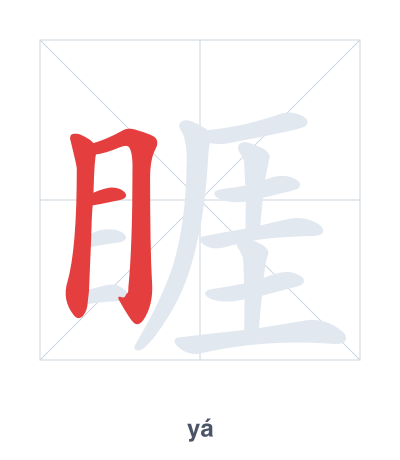
Open Hanzi Writer to see the animated stroke order and practice writing 睚 with real-time feedback.
The character 睚 (yá) is written with 13 strokes. Follow the standard Chinese stroke order: top to bottom, left to right, outside before inside. The radical 目 is one of its key components.
Practice the correct stroke order with the Hanzi Writer app to see animated stroke-by-stroke guidance with real-time feedback.
睚 means Eye socket; to stare..
睚 combines the radical 目 (eye) with 厓 (cliff) as a phonetic component. The character originally referred to the eye socket, the bony hollow around the eye, and by extension came to mean 'to stare' intensely, as if fixing one's gaze on a distant cliff edge.
💡 Memory Tip: Picture a person on a cliff (厓) staring so hard with their eye (目) that their eyeball almost pops out of the socket—睚.
两人产生了一些睚眦。
liǎng rén chǎn shēng le yī xiē yá zì
Some small grievances arose between the two.
这个人睚眦必报。
zhè ge rén yá zì bì bào
This person is very vindictive and seeks revenge for the smallest grievance.
这只是睚眦之怨。
zhè zhǐ shì yá zì zhī yuàn
This is just a minor grudge.
Open Hanzi Writer to see the animated stroke order and practice writing 睚 with real-time feedback.
✨ Animated stroke order · Handwriting recognition · HSK-graded practice · Free to use
睚 is made of the radical 目 (eye) on the left, which directly relates to seeing or staring, and the phonetic component 厓 (yá) on the right. This combination creates a character that means "eye socket" or "to stare," with the eye radical giving the visual meaning.