悟 (wù) means "realize" in Chinese. It has 10 strokes with the radical 忄, and is HSK Level 6.
Rated 4.2/5 in difficulty (advanced).
Harder than 59% of HSK Level 6 characters.
Appears in 3+ common words including 觉悟 (jué wù), 领悟 (lǐng wù), 悟性 (wù xìng).
Due to its 10 strokes, Hanzi Writer's error detection shows 悟 requires focused practice — most learners need 10+ attempts for consistent accuracy.
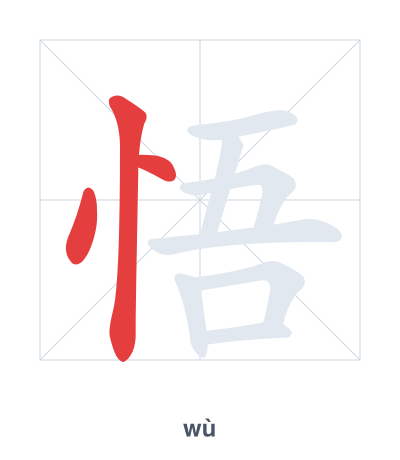
Open Hanzi Writer to see the animated stroke order and practice writing 悟 with real-time feedback.
The character 悟 (wù) is written with 10 strokes. Follow the standard Chinese stroke order: top to bottom, left to right, outside before inside. The radical 忄 is one of its key components.
Practice the correct stroke order with the Hanzi Writer app to see animated stroke-by-stroke guidance with real-time feedback.
悟 means realize.
As an HSK Level 6 character, 悟 is an intermediate-level character.
悟 combines the heart radical 忄 (mind/heart) with 吾 (wú, meaning 'I' or 'self'). The character suggests that true realization or awakening comes from one's own heart and mind—understanding from within.
💡 Memory Tip: Picture your heart (忄) suddenly seeing 'me' (吾) clearly—a moment of self-realization.
他的觉悟很高。
tā de jué wù hěn gāo
He has a high level of awareness.
我领悟了他的意思。
wǒ lǐng wù le tā de yì si
I grasped what he meant.
这个孩子很有悟性。
zhè ge hái zi hěn yǒu wù xìng
This child is very perceptive and quick to learn.
Open Hanzi Writer to see the animated stroke order and practice writing 悟 with real-time feedback.
✨ Animated stroke order · Handwriting recognition · HSK-graded practice · Free to use
悟 is made of the heart radical 忄 on the left and 吾 (wú, meaning 'I' or 'my') on the right. The heart radical shows that realizing is a mental or emotional process, while 吾 suggests that true understanding comes from within yourself.