袜 (wà) means "Sock or stocking" in Chinese. It has 10 strokes with the radical 衤, and is HSK Level 4.
Rated 4.2/5 in difficulty (advanced).
Harder than 91% of HSK Level 4 characters.
Appears in 3+ common words including 袜子 (wà zi), 穿袜 (chuān wà), 棉袜 (mián wà).
Due to its 10 strokes, Hanzi Writer's error detection shows 袜 requires focused practice — most learners need 10+ attempts for consistent accuracy.
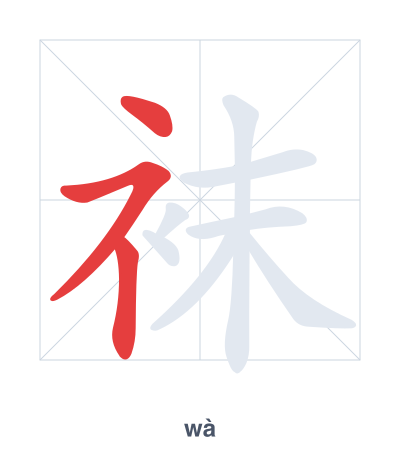
Open Hanzi Writer to see the animated stroke order and practice writing 袜 with real-time feedback.
The character 袜 (wà) is written with 10 strokes. Follow the standard Chinese stroke order: top to bottom, left to right, outside before inside. The radical 衤 is one of its key components.
Practice the correct stroke order with the Hanzi Writer app to see animated stroke-by-stroke guidance with real-time feedback.
袜 means Sock or stocking.
As an HSK Level 4 character, 袜 is an intermediate-level character.
袜 is a compound character with the radical 衤 (clothing) on the left and 末 (mò, meaning 'tip' or 'end') on the right. The clothing radical indicates that it is an item of attire, while 末 suggests the tip of the foot that the sock covers.
💡 Memory Tip: Picture a sock covering the end of your foot, with the right side 末 looking like a little foot with toes pointing to the tip.
这双袜子是纯棉的。
zhè shuāng wà zi shì chún mián de
This pair of socks is pure cotton.
出门前记得穿袜。
chū mén qián jì de chuān wà
Remember to put on socks before going out.
冬天穿棉袜很暖和。
dōng tiān chuān mián wà hěn nuǎn huo
Wearing cotton socks in winter is very warm.
Open Hanzi Writer to see the animated stroke order and practice writing 袜 with real-time feedback.
✨ Animated stroke order · Handwriting recognition · HSK-graded practice · Free to use
The left side is the radical 衤, which is a simplified form of 衣 (clothing), and the right side is 末 (mò, meaning 'tip' or 'end'). Together, they suggest a piece of clothing worn at the end of the leg, which is a sock.