衲 (nà) means "to patch (clothes); monk's robe" in Chinese. It has 9 strokes with the radical 衤.
Rated 4/5 in difficulty (challenging).
Appears in 3+ common words including 老衲 (lǎo nà), 补衲 (bǔ nà), 衲衣 (nà yī).
Due to its 9 strokes, Hanzi Writer's error detection shows 衲 requires focused practice — most learners need 10+ attempts for consistent accuracy.
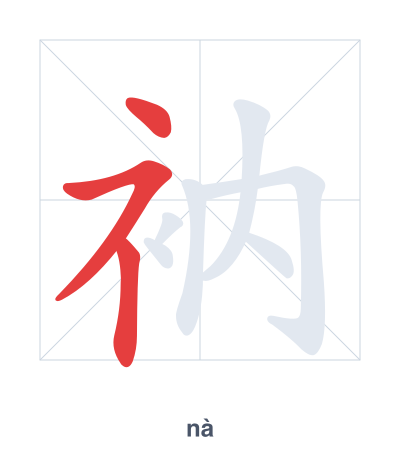
Open Hanzi Writer to see the animated stroke order and practice writing 衲 with real-time feedback.
The character 衲 (nà) is written with 9 strokes. Follow the standard Chinese stroke order: top to bottom, left to right, outside before inside. The radical 衤 is one of its key components.
Practice the correct stroke order with the Hanzi Writer app to see animated stroke-by-stroke guidance with real-time feedback.
衲 means to patch (clothes); monk's robe.
衲 combines the clothing radical 衤 with 内 (inside), suggesting sewing patches on the inside of garments—originally referring to mending clothes, later extended to a monk's patched robe.
💡 Memory Tip: Imagine a monk's robe with a large patch (衤) sewn on the inside (内), hiding a secret pocket for alms.
老衲住在山里。
lǎo nà zhù zài shān lǐ
The old monk lives in the mountains.
他在补衲旧衣服。
tā zài bǔ nà jiù yī fú
He is patching old clothes.
这件衲衣很旧了。
zhè jiàn nà yī hěn jiù le
This monk's robe is very old.
Open Hanzi Writer to see the animated stroke order and practice writing 衲 with real-time feedback.
✨ Animated stroke order · Handwriting recognition · HSK-graded practice · Free to use
The left side 衤 is the clothing radical, indicating that 衲 relates to garments. The right side 内 (nèi, meaning 'inside') gives a phonetic hint and also suggests adding a patch inside a robe. Together, the character means 'to patch clothes' or a monk's patched robe.