衽 (rèn) means "lapel; sleeping mat" in Chinese. It has 9 strokes with the radical 衤.
Rated 4/5 in difficulty (challenging).
Appears in 3+ common words including 衣衽 (yī rèn), 敛衽 (liǎn rèn), 衽席 (rèn xí).
Due to its 9 strokes, Hanzi Writer's error detection shows 衽 requires focused practice — most learners need 10+ attempts for consistent accuracy.
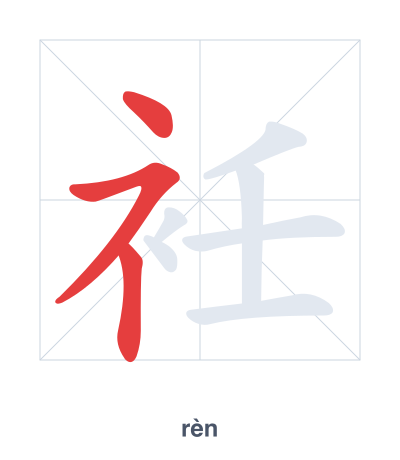
Open Hanzi Writer to see the animated stroke order and practice writing 衽 with real-time feedback.
The character 衽 (rèn) is written with 9 strokes. Follow the standard Chinese stroke order: top to bottom, left to right, outside before inside. The radical 衤 is one of its key components.
Practice the correct stroke order with the Hanzi Writer app to see animated stroke-by-stroke guidance with real-time feedback.
衽 means lapel; sleeping mat.
衽 combines the clothing radical 衤 (衣) with 壬 (rén), which originally depicted a spindle but here serves as a phonetic hint. The character refers to the overlapping front part of a garment (lapel) or a sleeping mat made of cloth, linking clothing to its practical use.
💡 Memory Tip: Imagine a person (壬) wearing a robe (衤) and lying on a mat that folds over like a lapel—the mat is the 衽.
他的衣衽很整齐。
tā de yī rèn hěn zhěng qí
The lapels of his clothes are very neat.
她敛衽行礼。
tā liǎn rèn xíng lǐ
She adjusted her dress and bowed.
衽席要保持干净。
rèn xí yào bǎo chí gān jìng
Bedding should be kept clean.
Open Hanzi Writer to see the animated stroke order and practice writing 衽 with real-time feedback.
✨ Animated stroke order · Handwriting recognition · HSK-graded practice · Free to use
衽 is made of the clothing radical 衤 on the left and the phonetic component 壬 on the right. The radical 衤 links the character to garments, explaining meanings like "lapel" or parts of clothing. The right side gives the pronunciation rèn.