衿 (jīn) means "lapel; collar" in Chinese. It has 9 strokes with the radical 衤.
Rated 4/5 in difficulty (challenging).
Appears in 3+ common words including 青衿 (qīng jīn), 衿甲 (jīn jiǎ), 衿带 (jīn dài).
Due to its 9 strokes, Hanzi Writer's error detection shows 衿 requires focused practice — most learners need 10+ attempts for consistent accuracy.
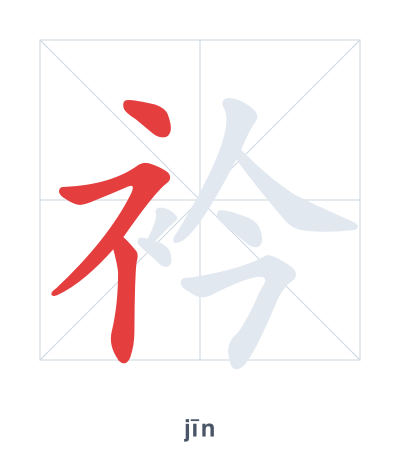
Open Hanzi Writer to see the animated stroke order and practice writing 衿 with real-time feedback.
The character 衿 (jīn) is written with 9 strokes. Follow the standard Chinese stroke order: top to bottom, left to right, outside before inside. The radical 衤 is one of its key components.
Practice the correct stroke order with the Hanzi Writer app to see animated stroke-by-stroke guidance with real-time feedback.
衿 means lapel; collar.
衿 is a compound character: the radical 衤 (clothing) indicates its connection to garments, while 今 (jīn) provides the phonetic hint. In ancient Chinese robes, the 衿 referred to the overlapping front panels that form the lapel or collar area, securing the garment.
💡 Memory Tip: Picture a robe (衤) with a collar shaped like the top of a clock (今), showing that the 'present' (今) moment you wear it, your lapel stands out.
他穿着一件青衿。
tā chuān zhe yī jiàn qīng jīn
He is wearing a scholar's blue-collared robe.
战士穿着衿甲。
zhàn shì chuān zhe jīn jiǎ
The soldier is wearing collar armor.
衣服的衿带开了。
yī fú de jīn dài kāi le
The tie of the garment has come undone.
Open Hanzi Writer to see the animated stroke order and practice writing 衿 with real-time feedback.
✨ Animated stroke order · Handwriting recognition · HSK-graded practice · Free to use
The character 衿 is made of the radical 衤 (clothing) on the left and the phonetic component 今 (jīn) on the right. The radical 衤 shows that the character relates to clothing, and 衿 specifically means the lapel or collar of a garment.