衩 (chǎ) means "slit (in a garment)" in Chinese. It has 8 strokes with the radical 衤.
Rated 3.7/5 in difficulty (challenging).
Appears in 3+ common words including 裤衩 (kù chǎ), 开衩 (kāi chǎ), 衩口 (chǎ kǒu).
Due to its 8 strokes, Hanzi Writer's error detection shows 衩 requires focused practice — most learners need 10+ attempts for consistent accuracy.
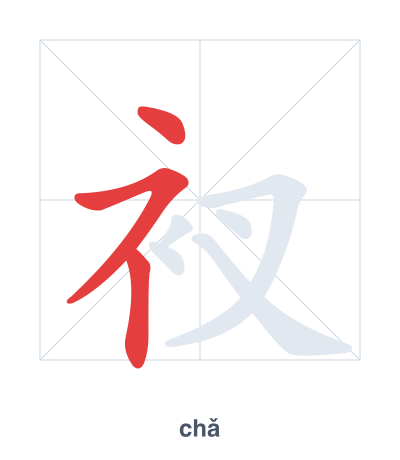
Open Hanzi Writer to see the animated stroke order and practice writing 衩 with real-time feedback.
The character 衩 (chǎ) is written with 8 strokes. Follow the standard Chinese stroke order: top to bottom, left to right, outside before inside. The radical 衤 is one of its key components.
Practice the correct stroke order with the Hanzi Writer app to see animated stroke-by-stroke guidance with real-time feedback.
衩 means slit (in a garment).
衩 combines the clothing radical 衤 with 叉 (chā, 'fork'). The 叉 component visually suggests a V-shaped opening, so together they depict a forked slit in a garment, which is the meaning.
💡 Memory Tip: Imagine a fancy dress with a fork (叉) stuck right into the side slit (衤) to hold it open.
他穿着短裤衩去跑步。
tā chuān zhe duǎn kù chǎ qù pǎo bù
He went running in shorts.
这件旗袍开衩很高。
zhè jiàn qí páo kāi chǎ hěn gāo
The slit of this cheongsam is very high.
衣服的衩口裂开了。
yī fú de chǎ kǒu liè kāi le
The slit of the clothes has torn open.
Open Hanzi Writer to see the animated stroke order and practice writing 衩 with real-time feedback.
✨ Animated stroke order · Handwriting recognition · HSK-graded practice · Free to use
The character 衩 is composed of the radical 衤 (clothes) on the left and the component 叉 (fork) on the right. The clothes radical connects it to garments, while 叉 suggests a split or division, together forming the meaning of a slit in clothing.