Hanzi Writer

How to Write 帖 (tiē/tiě/tiè) — Meaning “A post, note, or invitation.”

tiē/tiě/tiè HSK Level 7 8 strokes Radical: 巾

帖 (tiē/tiě/tiè) means "A post, note, or invitation." in Chinese. It has 8 strokes with the radical 巾, and is HSK Level 7.

Rated 3.7/5 in difficulty (challenging).

Harder than 25% of HSK Level 7 characters.

Appears in 6+ common words including 妥帖 (tuǒ tiē), 伏帖 (fú tiē), 帖子 (tiě zi).

Due to its 8 strokes, Hanzi Writer's error detection shows 帖 requires focused practice — most learners need 10+ attempts for consistent accuracy.
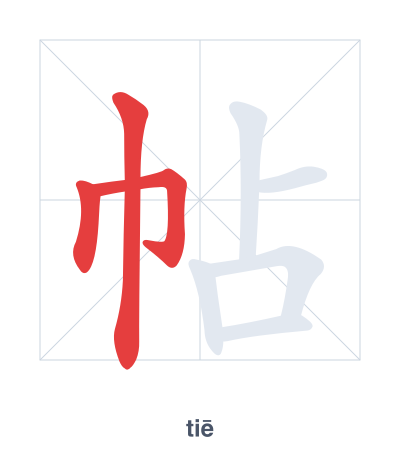
Stroke order practice for 帖 - tiē/tiě/tiè

Practice Writing 帖 (tiē/tiě/tiè)

Open Hanzi Writer to see the animated stroke order and practice writing 帖 with real-time feedback.

The character (tiē/tiě/tiè) is written with 8 strokes. Follow the standard Chinese stroke order: top to bottom, left to right, outside before inside. The radical is one of its key components.

Practice the correct stroke order with the Hanzi Writer app to see animated stroke-by-stroke guidance with real-time feedback.

means A post, note, or invitation..

This is a polyphonic character with readings: tiē, tiě, tiè.

As an HSK Level 7 character, is an intermediate-level character.

Character
Pinyintiē / tiě / tiè (tie)
MeaningA post, note, or invitation.
Strokes8
Radical
HSK Level7
Difficulty3.7/5

帖 is a phono-semantic compound combining the radical 巾 (cloth) with 占 (zhān, to divine) as phonetic. Originally it meant a piece of cloth with writing, like a label or note, and later extended to refer to invitations, postings, or small documents.

💡 Memory Tip: Imagine a cloth (巾) with a divination mark (占) on it, used as an invitation to a fortuneteller's reading.

tuǒ tiē
Appropriate / Properly handled / Satisfactory.
fú tiē
Submissive / Well-settled
tiě zi
A post (online) or an invitation card.
qǐng tiě
Invitation card.
zì tiè
copybook for calligraphy
bēi tiè
Rubbings from stone inscriptions used for calligraphy practice.

他把这件琐碎的事情处理得非常妥帖。

tā bǎ zhè jiàn suǒ suì de shì qíng chǔ lǐ dé fēi cháng tuǒ tiē

He handled this trivial matter very appropriately.

这种药膏敷在皮肤上感觉非常伏帖。

zhè zhǒng yào gāo fū zài pí fū shàng gǎn jué fēi cháng fú tiē

This ointment feels very comfortable and adheres well when applied to the skin.

论坛上的这个帖子引起了网友们的广泛讨论。

lùn tán shàng de zhè ge tiě zi yǐn qǐ le wǎng yǒu men de guǎng fàn tǎo lùn

This post on the forum has sparked widespread discussion among netizens.

我们已经收到了老同学寄来的结婚请帖。

wǒ men yǐ jīng shōu dào le lǎo tóng xué jì lái de jié hūn qǐng tiě

We have already received the wedding invitation sent by an old classmate.

Character Pinyin Strokes Radical
(current) tiē / tiě / tiè 8
fān 6
shī 6
7
Stroke order practice for 帖 - tiē/tiě/tiè

Practice Writing 帖 (tiē/tiě/tiè)

Open Hanzi Writer to see the animated stroke order and practice writing 帖 with real-time feedback.

✨ Animated stroke order · Handwriting recognition · HSK-graded practice · Free to use

Frequently Asked Questions about 帖

帖 is made of the radical 巾 (cloth) on the left and 占 on the right. 巾 suggests something written on cloth—like a note or invitation—while 占 gives the sound tiē and hints at 'attaching' or 'fixing' information. Together, 帖 means a post, note, or invitation card.

More HSK Level 7 Characters

Characters with Radical 巾

Other 8-Stroke Characters