台 (tái) means "platform; stage; desk" in Chinese. It has 5 strokes with the radical 口, and is HSK Level 3.
Rated 2.9/5 in difficulty (moderate).
Harder than 22% of HSK Level 3 characters.
Appears in 3+ common words including 电视台 (diàn shì tái), 台阶 (tái jiē), 阳台 (yáng tái).
Hanzi Writer's stroke validation shows learners typically need 5-8 attempts to write 台 with correct proportion and order.
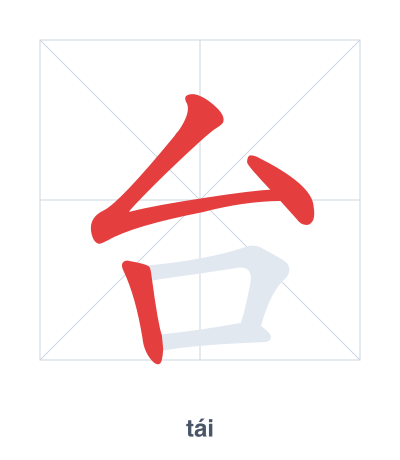
Open Hanzi Writer to see the animated stroke order and practice writing 台 with real-time feedback.
The character 台 (tái) is written with 5 strokes. Follow the standard Chinese stroke order: top to bottom, left to right, outside before inside. The radical 口 is one of its key components.
Practice the correct stroke order with the Hanzi Writer app to see animated stroke-by-stroke guidance with real-time feedback.
台 means platform; stage; desk.
As an HSK Level 3 character, 台 is an intermediate-level character.
The character 台 originally depicted a raised platform in ancient scripts, with the top part representing the elevated surface and the bottom 口 (mouth) indicating the area below. Over time, it came to mean 'platform,' 'stage,' or 'desk.'
💡 Memory Tip: Imagine a private performer (厶) standing on a stage (口), with the top part as their head and the mouth as the stage floor.
他在电视台工作。
tā zài diàn shì tái gōng zuò
He works at a TV station.
请小心台阶。
qǐng xiǎo xīn tái jiē
Please watch the steps.
阳台上有花。
yáng tái shàng yǒu huā
There are flowers on the balcony.
Open Hanzi Writer to see the animated stroke order and practice writing 台 with real-time feedback.
✨ Animated stroke order · Handwriting recognition · HSK-graded practice · Free to use
台 is a compound character with a 'mouth' radical (口) at the top and a 'platform' shape (厶) at the bottom. The mouth radical can suggest a speaker or sound, while the bottom part represents something flat and raised, together forming the idea of a stage or platform where people speak.