阳 (yáng) means "Sun, positive, or Yang." in Chinese. It has 6 strokes with the radical 阝, and is HSK Level 2.
Rated 2.4/5 in difficulty (moderate).
Harder than 23% of HSK Level 2 characters.
Appears in 3+ common words including 太阳 (tài yáng), 阳光 (yáng guāng), 阳台 (yáng tái).
Hanzi Writer's stroke validation shows learners typically need 5-8 attempts to write 阳 with correct proportion and order.
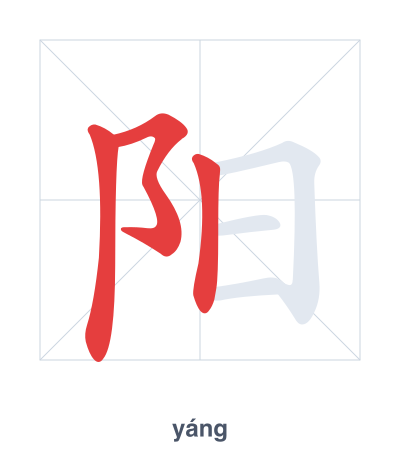
Open Hanzi Writer to see the animated stroke order and practice writing 阳 with real-time feedback.
The character 阳 (yáng) is written with 6 strokes. Follow the standard Chinese stroke order: top to bottom, left to right, outside before inside. The radical 阝 is one of its key components.
Practice the correct stroke order with the Hanzi Writer app to see animated stroke-by-stroke guidance with real-time feedback.
阳 means Sun, positive, or Yang..
As an HSK Level 2 character, 阳 is among the first characters beginners learn.
阳 combines the left radical 阝 (a mound or hill) with 日 (sun), originally depicting the sunny side of a hill. In ancient Chinese philosophy, this bright, southern slope gave rise to the meanings 'sun,' 'positive,' and the Yang principle.
💡 Memory Tip: Picture the sun (日) rising over a steep hill (阝), flooding the left side with light—that's the yang side.
今天的太阳很大。
jīn tiān de tài yáng hěn dà
The sun is very strong today.
房间里有阳光。
fáng jiān lǐ yǒu yáng guāng
There is sunlight in the room.
我在阳台看书。
wǒ zài yáng tái kàn shū
I'm reading on the balcony.
Open Hanzi Writer to see the animated stroke order and practice writing 阳 with real-time feedback.
✨ Animated stroke order · Handwriting recognition · HSK-graded practice · Free to use
阳 is made of two parts: the left radical 阝 (which comes from a pictograph of a hill) and the right side 日 (sun). This combination originally meant the sunny side of a hill, so the character represents sun, positive, and the Yang principle.