髓 (suǐ) means "marrow / essence" in Chinese. It has 21 strokes with the radical 骨, and is HSK Level 7.
Rated 4.2/5 in difficulty (advanced).
Harder than 99% of HSK Level 7 characters.
Appears in 3+ common words including 骨髓 (gǔ suǐ), 精髓 (jīng suǐ), 脑髓 (nǎo suǐ).
Due to its 21 strokes, Hanzi Writer's error detection shows 髓 requires focused practice — most learners need 10+ attempts for consistent accuracy.
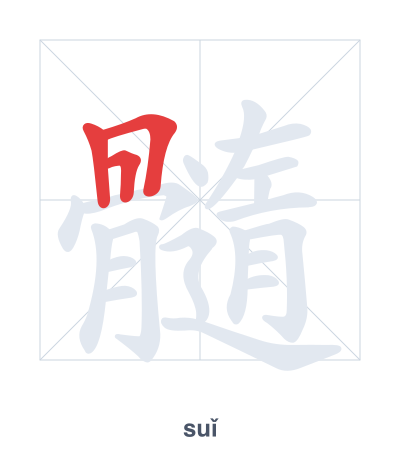
Open Hanzi Writer to see the animated stroke order and practice writing 髓 with real-time feedback.
The character 髓 (suǐ) is written with 21 strokes. Follow the standard Chinese stroke order: top to bottom, left to right, outside before inside. The radical 骨 is one of its key components.
Practice the correct stroke order with the Hanzi Writer app to see animated stroke-by-stroke guidance with real-time feedback.
髓 means marrow / essence.
As an HSK Level 7 character, 髓 is an intermediate-level character.
髓 is a phono-semantic compound: 骨 (bone) indicates the meaning of marrow found inside bones, and 隋 (suí) provides a phonetic clue to the pronunciation suǐ.
💡 Memory Tip: Imagine a bone (骨) that, when cracked open, reveals a bird (隹) made of pure marrow essence glowing like the moon (月) inside.
骨髓可以制造血液。
gǔ suǐ kě yǐ zhì zào xuè yè
Bone marrow can produce blood.
这是中国文化的精髓。
zhè shì zhōng guó wén huà de jīng suǐ
This is the essence of Chinese culture.
脑髓保护着神经。
nǎo suǐ bǎo hù zhe shén jīng
Brain tissue protects the nerves.
Open Hanzi Writer to see the animated stroke order and practice writing 髓 with real-time feedback.
✨ Animated stroke order · Handwriting recognition · HSK-graded practice · Free to use
髓 is made of the radical 骨 (bone) on the left, and the phonetic component 遂 (suì) on the right. The bone radical directly links to the meaning of marrow, which is the soft tissue inside bones. The right side provides the pronunciation suǐ while the overall structure shows that marrow is a substance located within bone.