髑 (dú) means "skull" in Chinese. It has 22 strokes with the radical 骨.
Rated 4.2/5 in difficulty (advanced).
Appears in 3+ common words including 髑髅 (dú lóu), 髑髅地 (dú lóu dì), 髑髅杯 (dú lóu bēi).
Due to its 22 strokes, Hanzi Writer's error detection shows 髑 requires focused practice — most learners need 10+ attempts for consistent accuracy.
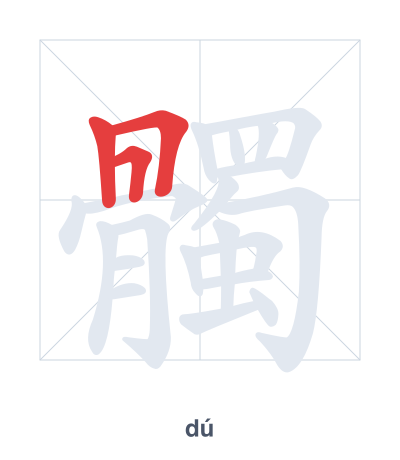
Open Hanzi Writer to see the animated stroke order and practice writing 髑 with real-time feedback.
The character 髑 (dú) is written with 22 strokes. Follow the standard Chinese stroke order: top to bottom, left to right, outside before inside. The radical 骨 is one of its key components.
Practice the correct stroke order with the Hanzi Writer app to see animated stroke-by-stroke guidance with real-time feedback.
髑 means skull.
| Character | 髑 |
| Pinyin | dú (du) |
| Meaning | skull |
| Strokes | 22 |
| Radical | 骨 |
| Difficulty | 4.2/5 |
髑 is a compound character formed with the radical 骨 (bone) on the left and the phonetic component 蜀 (shǔ) on the right. The radical indicates that the meaning relates to bones, and 蜀 provides a clue to pronunciation (though the actual reading is dú). In classical texts, 髑 appears in the term 髑髅 (dúlóu), meaning a skull or bare human cranium.
💡 Memory Tip: Imagine a bone (骨) with a creepy insect (蜀) sitting inside an empty skull—a vivid reminder that 髑 means skull.
洞穴里有一个髑髅。
dòng xué lǐ yǒu yí gè dú lóu
There is a skull in the cave.
那里被称为髑髅地。
nà lǐ bèi chēng wéi dú lóu dì
That place is called Golgotha.
这是一个古代的髑髅杯。
zhè shì yí gè gǔ dài de dú lóu bēi
This is an ancient skull cup.
Open Hanzi Writer to see the animated stroke order and practice writing 髑 with real-time feedback.
✨ Animated stroke order · Handwriting recognition · HSK-graded practice · Free to use
髑 is made of two parts: the left side is 骨 (bone), which gives the meaning related to bones, and the right side is 蜀 (shǔ), which provides the sound. Together, 髑 refers to a skull, which is a bone structure of the head.