癫 (diān) means "insane; crazy; epilepsy" in Chinese. It has 21 strokes with the radical 疒.
Rated 4.2/5 in difficulty (advanced).
Appears in 3+ common words including 癫痫 (diān xián), 疯癫 (fēng diān), 癫狂 (diān kuáng).
Due to its 21 strokes, Hanzi Writer's error detection shows 癫 requires focused practice — most learners need 10+ attempts for consistent accuracy.
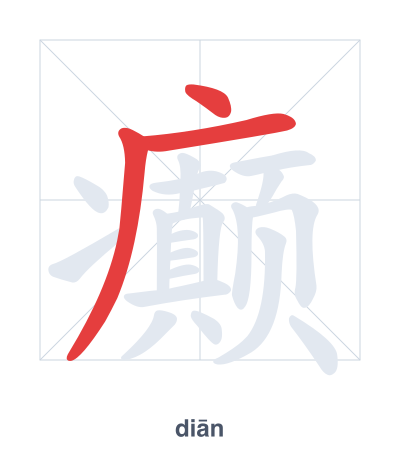
Open Hanzi Writer to see the animated stroke order and practice writing 癫 with real-time feedback.
The character 癫 (diān) is written with 21 strokes. Follow the standard Chinese stroke order: top to bottom, left to right, outside before inside. The radical 疒 is one of its key components.
Practice the correct stroke order with the Hanzi Writer app to see animated stroke-by-stroke guidance with real-time feedback.
癫 means insane; crazy; epilepsy.
The character 癫 combines the illness radical 疒 with 顛 (meaning 'to fall' or 'head'), indicating a disease that makes a person fall down, as in an epileptic seizure. The right component 顛 also provides the pronunciation diān. This structure ties the concept of insanity or epilepsy to a physical collapse, reflecting both symptoms and sound.
💡 Memory Tip: Imagine a sick person (疒) who keeps tumbling headfirst (顛) and acting wildly—that's the crazy, epileptic 癫.
他突发癫痫。
tā tū fā diān xián
He had a sudden seizure.
他的样子很疯癫。
tā de yàng zi hěn fēng diān
He looks very crazy.
这种行为太癫狂。
zhè zhǒng xíng wéi tài diān kuáng
This behavior is too frantic.
Open Hanzi Writer to see the animated stroke order and practice writing 癫 with real-time feedback.
✨ Animated stroke order · Handwriting recognition · HSK-graded practice · Free to use
癫 has the radical 疒 (illness) on the outside, showing it relates to a disease. Inside is 顛 (diān), which gives the sound and hints at 'top' or 'upside down' — together they suggest a mental illness that turns the mind upside down.