夔 (kuí) means "Kui (a legendary one-legged monster)" in Chinese. It has 21 strokes with the radical 夂.
Rated 3.8/5 in difficulty (challenging).
Appears in 3+ common words including 夔牛 (kuí niú), 夔门 (kuí mén), 夔州 (kuí zhōu).
Due to its 21 strokes, Hanzi Writer's error detection shows 夔 requires focused practice — most learners need 10+ attempts for consistent accuracy.
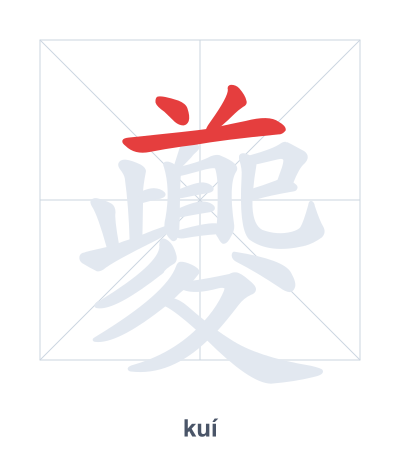
Open Hanzi Writer to see the animated stroke order and practice writing 夔 with real-time feedback.
The character 夔 (kuí) is written with 21 strokes. Follow the standard Chinese stroke order: top to bottom, left to right, outside before inside. The radical 夂 is one of its key components.
Practice the correct stroke order with the Hanzi Writer app to see animated stroke-by-stroke guidance with real-time feedback.
夔 means Kui (a legendary one-legged monster).
| Character | 夔 |
| Pinyin | kuí (kui) |
| Meaning | Kui (a legendary one-legged monster) |
| Strokes | 21 |
| Radical | 夂 |
| Difficulty | 3.8/5 |
In ancient oracle bone script, 夔 depicted a mythical one-legged monster with a horned head, a large eye (目), and a single powerful leg ending in a foot (夂). The character evolved to include additional foot-like components (夊) to emphasize its hopping movement, visually capturing the creature's unique form.
💡 Memory Tip: Picture a one-eyed (目) monster hopping on one leg (夂), leaving a trail of two muddy footprints (夊) because it’s so heavy—that's Kui the legendary beast.
传说中有一种夔牛。
chuán shuō zhōng yǒu yī zhǒng kuí niú
Legend says there is a mythical creature called the Kui Niu.
夔门在长江三峡。
kuí mén zài cháng jiāng sān xiá
Kui Gate is located in the Three Gorges of the Yangtze River.
他出生在古时候的夔州。
tā chū shēng zài gǔ shí hòu de kuí zhōu
He was born in ancient Kuizhou.
Open Hanzi Writer to see the animated stroke order and practice writing 夔 with real-time feedback.
✨ Animated stroke order · Handwriting recognition · HSK-graded practice · Free to use
The character 夔 is composed of the radical 夂 (meaning "walk slowly") on top, with a complex lower part depicting a beast-like form. This structure suggests a creature that moves in a distinctive way, matching the legendary one-legged monster described in ancient texts.