禳 (ráng) means "To pray to avert evil or disaster" in Chinese. It has 21 strokes with the radical 礻.
Rated 3.8/5 in difficulty (challenging).
Appears in 3+ common words including 禳灾 (ráng zāi), 禳解 (ráng jiě), 禳除 (ráng chú).
Due to its 21 strokes, Hanzi Writer's error detection shows 禳 requires focused practice — most learners need 10+ attempts for consistent accuracy.
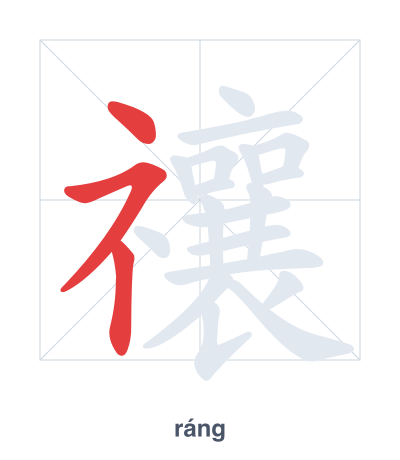
Open Hanzi Writer to see the animated stroke order and practice writing 禳 with real-time feedback.
The character 禳 (ráng) is written with 21 strokes. Follow the standard Chinese stroke order: top to bottom, left to right, outside before inside. The radical 礻 is one of its key components.
Practice the correct stroke order with the Hanzi Writer app to see animated stroke-by-stroke guidance with real-time feedback.
禳 means To pray to avert evil or disaster.
禳 combines the radical 礻 (altar/sacrifice) with phonetic component 襄 (xiāng, originally meaning 'to remove' or 'assist'), depicting a ritual offering used to dispel misfortune. The character visually represents ancient shamanic practices of praying to avert evil or disaster through sacrificial rites.
💡 Memory Tip: Picture a shaman at an altar (礻) wrapping evil spirits in cloth (the 衣 inside 襄) and tossing them away to avert disaster.
这种仪式可以禳灾。
zhè zhǒng yí shì kě yǐ ráng zāi
This ceremony can ward off disasters.
他请人来禳解厄运。
tā qǐng rén lái ráng jiě è yùn
He asked someone to perform a ritual to ward off bad luck.
祈求禳除一切病痛。
qí qiú ráng chú yī qiè bìng tòng
Pray to dispel all illnesses and pain.
Open Hanzi Writer to see the animated stroke order and practice writing 禳 with real-time feedback.
✨ Animated stroke order · Handwriting recognition · HSK-graded practice · Free to use
The left side is the radical 礻 (shì), which means 'spirit' or 'show' and connects the character to prayer and spiritual rituals. The right side is 襄 (xiāng), which provides the pronunciation ráng and originally meant 'to assist' or 'to remove,' combining with the radical to suggest praying for the removal of disasters.