礴 (bó) means "vast; filling up (usually in 'majestic')" in Chinese. It has 21 strokes with the radical 石.
Rated 4.2/5 in difficulty (advanced).
Appears in 3+ common words including 磅礴 (páng bó), 礴礴 (bó bó), 郁礴 (yù bó).
Due to its 21 strokes, Hanzi Writer's error detection shows 礴 requires focused practice — most learners need 10+ attempts for consistent accuracy.
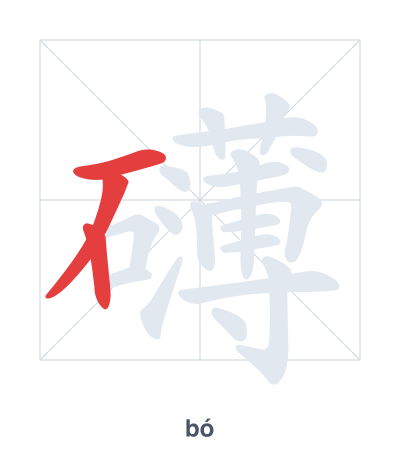
Open Hanzi Writer to see the animated stroke order and practice writing 礴 with real-time feedback.
The character 礴 (bó) is written with 21 strokes. Follow the standard Chinese stroke order: top to bottom, left to right, outside before inside. The radical 石 is one of its key components.
Practice the correct stroke order with the Hanzi Writer app to see animated stroke-by-stroke guidance with real-time feedback.
礴 means vast; filling up (usually in 'majestic').
礴 is a phono-semantic compound: the left radical 石 (stone) suggests massive solidity, while the right side 薄 (bó, meaning 'thin') provides the pronunciation and hints at spreading out, together conveying the idea of something as vast and filling as a colossal rock formation.
💡 Memory Tip: Picture a stone (石) so thin (薄) that it spreads like a giant sheet, filling the entire land with majestic vastness.
大山的气势很磅礴。
dà shān de qì shì hěn páng bó
The mountain's presence is majestic.
云气礴礴地升起。
yún qì bó bó dì shēng qǐ
The mist rises majestically.
山间郁礴着雾气。
shān jiān yù bó zhe wù qì
Mist is billowing in the mountains.
Open Hanzi Writer to see the animated stroke order and practice writing 礴 with real-time feedback.
✨ Animated stroke order · Handwriting recognition · HSK-graded practice · Free to use
礴 is formed by the radical 石 (stone) on the left and 溥 (pǔ, meaning 'widespread') on the right. The stone radical suggests something solid and massive, while 溥 conveys the idea of spreading or vastness, so together they mean 'vast and majestic.'