髌 (bìn) means "patella / kneecap" in Chinese. It has 19 strokes with the radical 骨.
Rated 4.2/5 in difficulty (advanced).
Appears in 3+ common words including 髌骨 (bìn gǔ), 髌韧带 (bìn rèn dài), 髌腱炎 (bìn jiàn yán).
Due to its 19 strokes, Hanzi Writer's error detection shows 髌 requires focused practice — most learners need 10+ attempts for consistent accuracy.
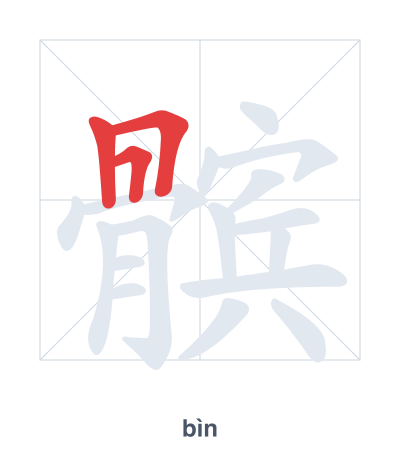
Open Hanzi Writer to see the animated stroke order and practice writing 髌 with real-time feedback.
The character 髌 (bìn) is written with 19 strokes. Follow the standard Chinese stroke order: top to bottom, left to right, outside before inside. The radical 骨 is one of its key components.
Practice the correct stroke order with the Hanzi Writer app to see animated stroke-by-stroke guidance with real-time feedback.
髌 means patella / kneecap.
| Character | 髌 |
| Pinyin | bìn (bin) |
| Meaning | patella / kneecap |
| Strokes | 19 |
| Radical | 骨 |
| Difficulty | 4.2/5 |
髌 is a phono-semantic compound. The radical 骨 (bone) indicates it refers to a specific bone, and the phonetic component 賓 (bīn) provides pronunciation. It specifically denotes the patella or kneecap, the small bone in front of the knee joint.
💡 Memory Tip: Picture a guest (賓) kneeling and hitting their kneecap (骨) so hard it breaks the bone — ouch, that's the 髌!
髌骨就是膝盖骨。
bìn gǔ jiù shì xī gài gǔ
The patella is the kneecap.
他的髌韧带拉伤了。
tā de bìn rèn dài lā shāng le
His patellar ligament is strained.
运动员容易得髌腱炎。
yùn dòng yuán róng yì dé bìn jiàn yán
Athletes are prone to patellar tendonitis.
Open Hanzi Writer to see the animated stroke order and practice writing 髌 with real-time feedback.
✨ Animated stroke order · Handwriting recognition · HSK-graded practice · Free to use
髌 is composed of the radical 骨 (bone) on the left, indicating it relates to bones, and the phonetic component 宾 (bīn, guest) on the right. Together, they form a word for a specific bone in the knee. The 骨 radical gives the category, while 宾 provides pronunciation guidance.