Hanzi Writer

How to Write 曩 (nǎng) — Meaning “past / former times”

nǎng 21 strokes Radical: 日

曩 (nǎng) means "past / former times" in Chinese. It has 21 strokes with the radical 日.

Rated 4.2/5 in difficulty (advanced).

Appears in 3+ common words including 曩日 (nǎng rì), 曩昔 (nǎng xī), 曩时 (nǎng shí).

Due to its 21 strokes, Hanzi Writer's error detection shows 曩 requires focused practice — most learners need 10+ attempts for consistent accuracy.
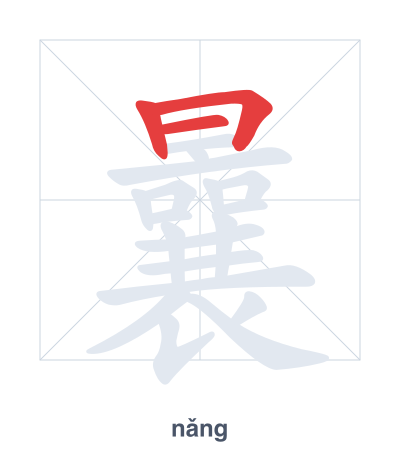
Stroke order practice for 曩 - nǎng

Practice Writing 曩 (nǎng)

Open Hanzi Writer to see the animated stroke order and practice writing 曩 with real-time feedback.

The character (nǎng) is written with 21 strokes. Follow the standard Chinese stroke order: top to bottom, left to right, outside before inside. The radical is one of its key components.

Practice the correct stroke order with the Hanzi Writer app to see animated stroke-by-stroke guidance with real-time feedback.

means past / former times.

Character
Pinyinnǎng (nang)
Meaningpast / former times
Strokes21
Radical
Difficulty4.2/5

曩 is a phonetic-semantic compound combining the sun radical 日 (indicating time) with 襄 (xiāng) as a phonetic component. The sun radical roots the character in the concept of days or time, and the whole character came to mean 'past' or 'former times.'

💡 Memory Tip: Picture the sun (日) wrapped in layers of old, dusty cloth (襄) to represent the distant past.

nǎng rì
former days / in the past
nǎng xī
in the past / olden days
nǎng shí
former times / in the past

曩日的朋友再见。

nǎng rì de péng yǒu zài jiàn

Seeing friends from the past again.

曩昔的事情忘了。

nǎng xī de shì qíng wàng le

I've forgotten things from the past.

曩时这里很安静。

nǎng shí zhè lǐ hěn ān jìng

It used to be very quiet here.

Character Pinyin Strokes Radical
(current) nǎng 21
bào / pù 19
20
Stroke order practice for 曩 - nǎng

Practice Writing 曩 (nǎng)

Open Hanzi Writer to see the animated stroke order and practice writing 曩 with real-time feedback.

✨ Animated stroke order · Handwriting recognition · HSK-graded practice · Free to use

Frequently Asked Questions about 曩

曩 has the radical 日 (sun/day) on top, which connects it to time. The lower part is a phonetic component that gives the pronunciation nǎng. Together, they form a character meaning 'past' or 'former times'.

Characters with Radical 日

Other 21-Stroke Characters