蒜 (suàn) means "garlic" in Chinese. It has 13 strokes with the radical 艹, and is HSK Level 7.
Rated 4.2/5 in difficulty (advanced).
Harder than 87% of HSK Level 7 characters.
Appears in 3+ common words including 大蒜 (dà suàn), 蒜头 (suàn tóu), 蒜泥 (suàn ní).
Due to its 13 strokes, Hanzi Writer's error detection shows 蒜 requires focused practice — most learners need 10+ attempts for consistent accuracy.
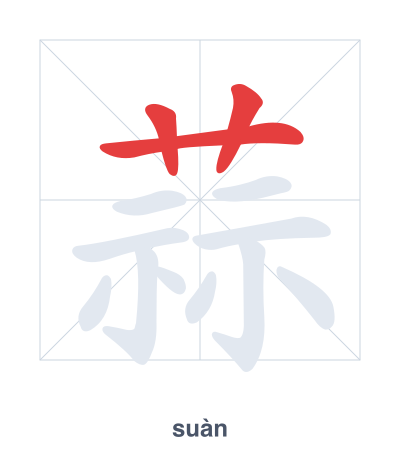
Open Hanzi Writer to see the animated stroke order and practice writing 蒜 with real-time feedback.
The character 蒜 (suàn) is written with 13 strokes. Follow the standard Chinese stroke order: top to bottom, left to right, outside before inside. The radical 艹 is one of its key components.
Practice the correct stroke order with the Hanzi Writer app to see animated stroke-by-stroke guidance with real-time feedback.
蒜 means garlic.
As an HSK Level 7 character, 蒜 is an intermediate-level character.
蒜 is a phono-semantic compound: the radical 艹 indicates it's a plant, while 祘 (suàn) provides the pronunciation. 祘 itself is an ancient character meaning 'to calculate,' possibly referring to the way garlic cloves are counted.
💡 Memory Tip: Picture two garlic bulbs (祘) sprouting under a grassy cover (艹), ready to be counted for cooking.
我不喜欢吃大蒜。
wǒ bù xǐ huān chī dà suàn
I don't like eating garlic.
厨房里有几个蒜头。
chú fáng lǐ yǒu jǐ gè suàn tóu
There are several garlic bulbs in the kitchen.
菜里放一点蒜泥。
cài lǐ fàng yì diǎn suàn ní
Put a little mashed garlic in the dish.
Open Hanzi Writer to see the animated stroke order and practice writing 蒜 with real-time feedback.
✨ Animated stroke order · Handwriting recognition · HSK-graded practice · Free to use
The top part 艹 is the grass radical, showing that garlic is a plant. The bottom part 祘 provides the pronunciation "suàn" and resembles two cloves inside a bulb. Together they form the character for garlic.