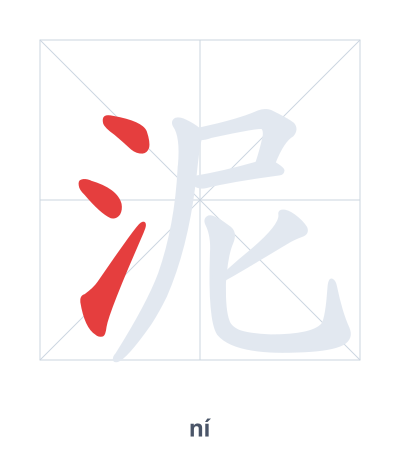
泥 (ní) means "Mud; clay." in Chinese. It has 8 strokes with the radical 氵, and is HSK Level 6. Difficulty: 3.7/5.
Mud; clay.
The character 泥 (ní) is written with 8 strokes. Follow the standard Chinese stroke order: top to bottom, left to right, outside before inside. The radical 氵 is one of its key components.
Practice the correct stroke order with the Hanzi Writer app to see animated stroke-by-stroke guidance with real-time feedback.
泥 is pronounced ní in Mandarin Chinese. It means Mud; clay..
This is a polyphonic character with readings: ní, nì.
As an HSK Level 6 character, 泥 is an intermediate-level character.
刚下过雨的田野里散发出泥土的芳香。
gāng xià guò yǔ de tián yě lǐ sàn fà chū ní tǔ de fāng xiāng
The fields just after the rain give off the fragrance of soil.
这里的道路非常泥泞,汽车很难通过。
zhè lǐ de dào lù fēi cháng ní nìng qì chē hěn nán tōng guò
The roads here are very muddy, making it difficult for cars to pass.
读书要灵活运用,不能一味泥古不化。
dú shū yào líng huó yùn yòng bù néng yī wèi nì gǔ bù huà
One should apply what they read flexibly and not blindly stick to old ways.
我们在处理问题时不要拘泥于死板的教条。
wǒ men zài chǔ lǐ wèn tí shí bú yào jū nì yú sǐ bǎn de jiào tiáo
We should not stick to rigid dogmas when dealing with problems.
Open Hanzi Writer to see the animated stroke order and practice writing 泥 with real-time feedback.